

Beijing’s Global Governance Initiative is testing whether a more multipolar world can produce a more functional global order
Published 16 Sep, 2026 14:25
By Ladislav Zemánek, non-resident research fellow at China-CEE Institute and expert of the Valdai Discussion Club
By Ladislav Zemánek, non-resident research fellow at China-CEE Institute and expert of the Valdai Discussion Club
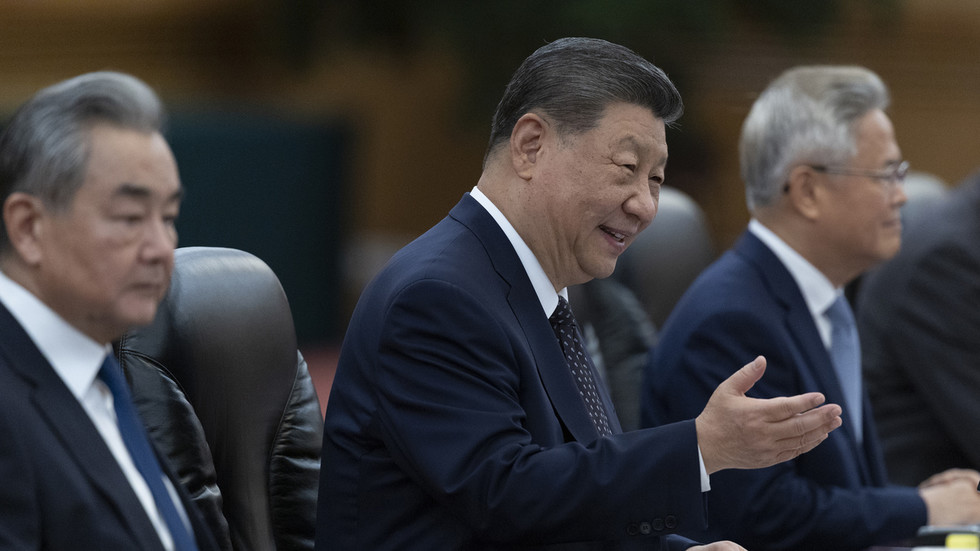
Chinese President Xi Jinping © China Pool / Getty Images
The latest SCO and BRICS summits offer a glimpse of a world no longer organized around a single center of gravity. As governments from Asia, Africa, Latin America, and elsewhere seek greater room to maneuver, the old architecture of global governance is under pressure – not necessarily because it has become irrelevant, but because the distribution of power around it has changed.
That is the backdrop against which China’s Global Governance Initiative, or GGI, enters its second year.
When President Xi Jinping unveiled the initiative at the SCO Plus meeting in Tianjin on September 1, 2025, it could easily have been dismissed as another diplomatic cliché. A year on, and China has begun translating the GGI into institutions dealing with mediation, data, and artificial intelligence, while embedding its principles in its longer-term economic and diplomatic planning.
A different map of globalization
The GGI starts from a proposition that the institutions of global governance have not kept pace with the distribution of global power. China’s preferred answer is not to abandon multilateralism but to dilute what it sees as its concentration in the hands of a small number of established powers. Sovereign equality is central: Every state, in principle, should have a voice regardless of its size, wealth, or political system.
This is where the GGI connects with China’s overall foreign policy. The Global Security Initiative emphasizes common security and strategic stability; the Global Development Initiative promotes development and economic integration; and the Global Civilization Initiative stresses dialogue across different civilizational traditions. The GGI provides an umbrella under which these ideas can be linked to the institutions of international governance.
Read more
China has little interest in a fragmented world economy. It is the main trading partner of more than 160 countries and regions and has concluded 24 free-trade agreements with 31 countries and regions. At the same time, Beijing rejects the idea that economic integration must entail political convergence on Western terms.
The post-Cold War model of globalization was built around the neoliberal ‘Washington Consensus’ and institutions whose center of gravity was largely Western. China’s alternative is a combination of economic openness with political sovereignty and strategic autonomy over development choices.
This is why Beijing’s opposition to trade wars, technology blockades, unilateral sanctions and protectionism sits comfortably alongside its advocacy of globalization. China wants interdependence to remain an economic asset without allowing it to become a political instrument of coercion.
The politics of the five deficits
The GGI also reflects China’s view of a world entering what might be called a polycrisis. Wars and geopolitical confrontation coexist with trade fragmentation, climate pressures, sovereign debt, and technological inequality. Beijing describes the result as five deficits: deficits of peace, development, security, governance, and trust.
For Beijing, today’s problems cannot be solved by reproducing yesterday’s hierarchy. A system designed when the global economy was dominated by the US and Europe, the argument goes, cannot indefinitely give those same actors disproportionate influence while countries across Asia, Africa, Latin America, and the Middle East acquire greater economic and political weight.
Chinese scholar Wang Yiwei has put it bluntly: Global governance should not mean governance by the US or the West, but governance by all countries, particularly the Global South, which represents about 80% of mankind.
That is the GGI’s most politically significant claim. It is also the one most likely to encounter resistance.
For the established powers, greater representation can sound like a euphemism for reducing their influence. For many developing countries, however, reform of global institutions has long been a matter of practicality, not ideology. The question is why their economic and demographic importance is not already better reflected in institutions governing finance, trade, technology, and security.
Read more
From slogans to institutions
During the GGI’s first year, Beijing has tried to give the concept institutional form.
In October 2025, the International Organization for Mediation began operations in Hong Kong. It is the first intergovernmental organization dedicated specifically to resolving international disputes through voluntary, non-binding mediation. Thirty-three countries became founding members. ‘Mediation’ fits China’s longstanding emphasis on negotiation and non-interference while addressing a genuine weakness in the international system: the growing difficulty of resolving disputes when major powers themselves are parties to them.
Two months later, China helped establish the Group of Friends of Global Governance at the United Nations, with 43 founding member states. This places the GGI inside the UN’s multilateral environment, rather than trying to establish a parallel system.
In March 2026, Beijing became home to another novelty: the World Data Organization. And in July, the World AI Conference and High-Level Meeting on Global AI Governance in Shanghai produced an agreement by 29 countries to establish the World AI Cooperation Organization, headquartered in Shanghai.
Mediation, data, and artificial intelligence are all governance gaps. Existing institutions were largely created before digital platforms, generative AI, and data flows became strategic assets. Whoever helps write the rules in these fields will have influence well beyond the conference room.
The United Nations is still the arena
The fact that China advocates a more multipolar order while simultaneously insisting that the United Nations remain at its center may seem like a paradox, but there really is no contradiction here: Beijing does not want to replace the existing system, but to change its internal balance.
China’s contribution to the UN regular budget rose from less than 1% in the year 2000 to more than 20% in 2025, making it the organization’s second-largest contributor after the US. Beijing has also placed implementation of the UN Pact for the Future at the heart of its diplomatic agenda.
Read more
The 15th Five-Year Plan for 2026-2030 calls for China’s participation in reforming global economic and financial governance, defending the multilateral trading system centered on the World Trade Organization, opposing protectionism, and expanding China’s network of free-trade agreements. That’s not the rhetoric of a country preparing to withdraw from the existing order.
The Shanghai Cooperation Organization (SCO) offers a model and a testing platform for Beijing’s project. At the Tianjin summit that coincided with the GGI’s launch, member states inaugurated four security centers and agreed to establish an SCO Development Bank.
An idea with deeper roots
The GGI isn’t China’s first attempt to articulate a theory of international order.
The Five Principles of Peaceful Coexistence, developed in the 1950s, placed sovereignty, non-interference, and equality at the center of China’s diplomatic thinking. In the 1970s, Mao Zedong’s Three Worlds theory offered a different interpretation of the global balance: Two superpowers dominated the international system, while developed and developing countries formed distinct political constituencies, with China identifying itself with the developing world.
The circumstances have changed radically. China’s own position has changed most of all. But the underlying concern with hierarchy and great-power dominance has survived.
There is an older Chinese intellectual reference point as well: Tianxia, or ‘all under Heaven’, imagined political order as extending beyond the boundaries of a single state. It was not a theory of modern sovereign equality and should not be projected mechanically onto today’s international system. Still, its emphasis on order, coexistence, and harmony provides part of the intellectual background for Beijing’s ideas of a global community.
The modern version is not a hierarchy centered on China, but a world conceived as an interconnected whole in which civilizations can cooperate without becoming identical.
Read more
The hard part begins now
The GGI’s first year has demonstrated that China can mobilize diplomatic support and help create institutions. The harder task is demonstrating that these institutions can produce international public goods. That will require more than conferences and declarations.
Can mediation prevent disputes from escalating when the interests of major powers collide? Can new institutions for data and AI produce rules that countries outside China’s political orbit genuinely accept? Can the SCO and BRICS convert their growing membership and economic weight into effective collective action? And can China persuade countries that a more multipolar order will mean not simply a redistribution of power among great states, but greater agency for smaller and developing ones?
The GGI does not offer a fully worked-out alternative world order, and that may ultimately be its strength. Its ambition is to make an existing system more representative, more inclusive and, crucially, more capable of delivering results.
China’s underlying bet is that the international order is already moving toward multipolarity and that institutions will either adapt to that reality or lose legitimacy. As the Chinese government has put it, mankind is destined to move “from confrontation to cooperation, imbalance to balance, division to coexistence.”
