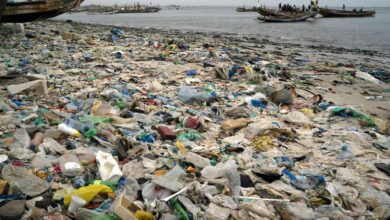
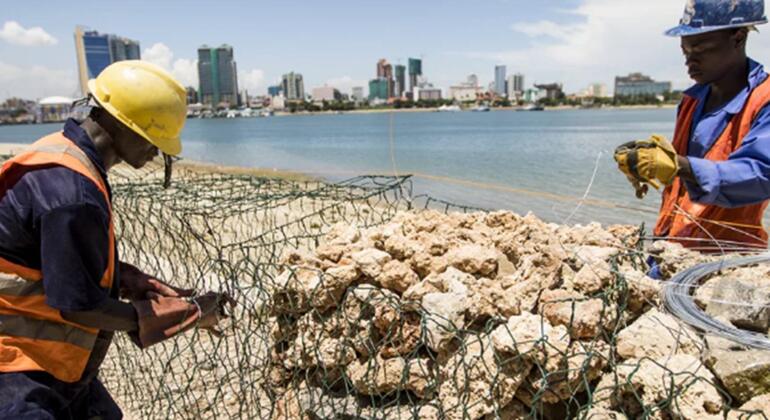
 Along the coast of Tanzania, in East Africa, the Indian Ocean is pushing saltwater ever farther inland, shrinking coconut harvests, driving fish away and leaving some residents wondering how much longer they can stay.
Buga Steven can measure the advance of the sea in coconuts.
There was a time when his trees yielded about 5,000 of them. Today, he said, a harvest brings less than a third of that.
Diminishing returns
“And they are much smaller than before,” said the Tanzanian farmer, who lives in Pangani, on the country’s northeastern coast, where the local river meets the Indian Ocean.
There, seawater has pushed about eight kilometres inland along the Pangani river, according to the United Nations Environment Programme (UNEP), carrying salt into fields that once sustained farmers along its banks.
In places, mangroves are following the saltwater inland.
For Mr. Steven, their arrival amounts to a boundary marker: land that once supported agriculture is becoming something else. His conclusion is stark.
“Everyone living along the riverbanks where mangroves are growing should be given grants so they can move elsewhere,” he told UN News. “Those areas have already been taken over by mangroves.”
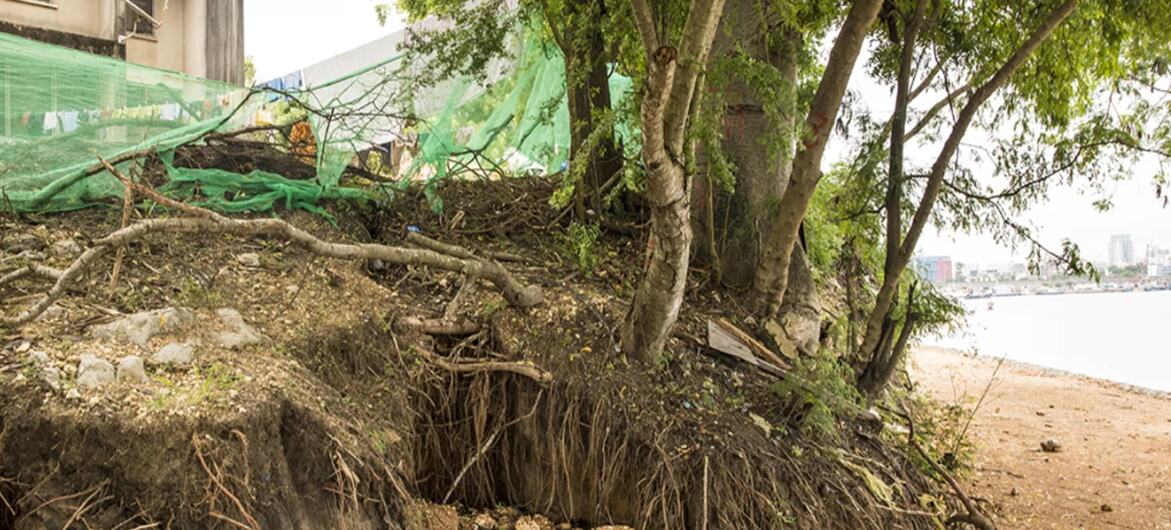
© UNOPS
Rising sea levels have eroded the beach area in Pangani, Tanga Region.
A coastline in retreat
The historic town of Pangani sits in a low-lying area where sea level rise is measured not so much in millimetres as in dwindling coconut harvests, salt in agricultural soil, and fish that no longer gather where fishermen expect to find them.
Iddi Hashimu Iddi has watched the transformation in his own coconut trees.
“The trunks were much thicker and healthier,” he said. “But rising sea levels have affected them. Salt has moved far inland, productivity has dropped, the trees are unhealthy, and many are dying. Our income has also fallen.”
For families living in the area, the losses spread quickly beyond the fields.
“We depended on coconut farming to sustain our livelihoods, educate our children, and meet social obligations,” Mr. Iddi said. “Now we face major challenges because of the impacts of sea level rise.”
The geography of the coconut trade itself is beginning to shift.
Take the high road
Haroub Selemani, a farmer and trader, says the larger coconuts increasingly come from higher ground.
“For those of us living from Matakani to Jasini, we no longer have proper coconuts,” he said. “If you want large coconuts, you have to go to places like Mafisi or Mseko and further uphill. That is where coconuts still grow large.”
The change poses a peculiar dilemma for some landowners. As saltwater spreads, mangroves are increasingly colonizing areas where coconut trees once grew. But mangroves are protected under Tanzanian law, Mr. Iddi said, leaving farmers unable simply to clear them.
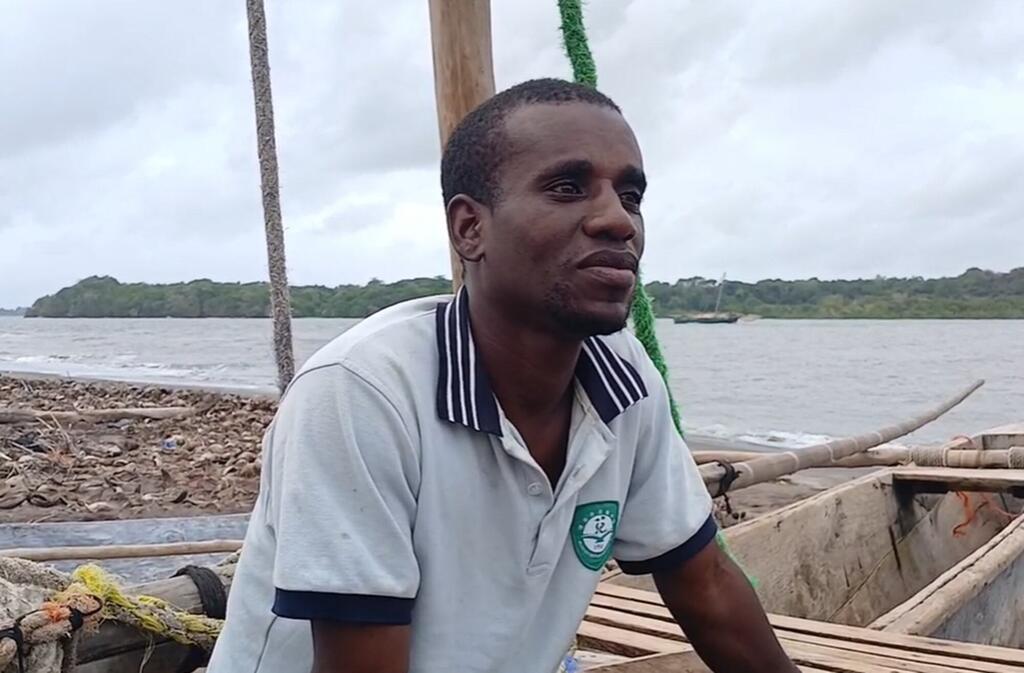
UN News
Ali Hamisi Daudi, a Fisherman sits in a wooden fishing boat along the Pangani shoreline on an overcast day.
“According to Government regulations, mangroves and coconut trees must compete, and whichever survives remains,” he said. “But if a landowner cuts mangroves, it becomes a serious offense because it violates government laws.”
The fish are moving, too
On the water, Ali Hamis Daudi has seen another Pangani disappear.
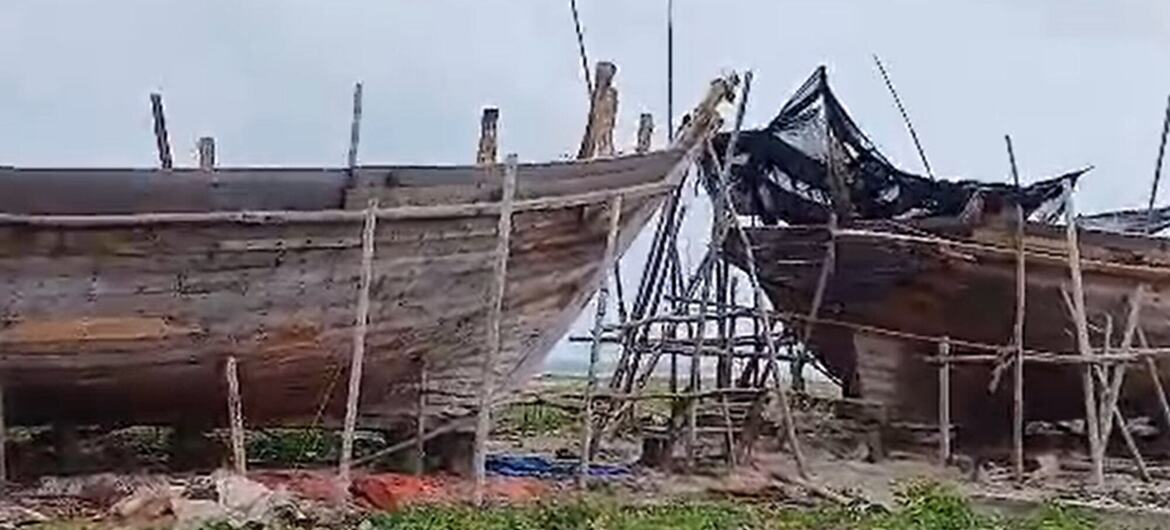
Shoreline erosion and the loss of trees have changed places where fishermen once anchored their boats. The knowledge passed down through fishing communities – where particular species congregate and at what depth – has become less reliable.
“If you come late, you may not find a place to anchor your boat,” Mr. Daudi said. “In the past, we knew exactly what depth of water certain fish species preferred. Now the fish have moved.”
Catching them, he said, has become a struggle.
The changes unfolding in Pangani are one local expression of a global shift.
Nearly 770 million people – roughly one in 10 people on Earth – live in coastal areas less than five metres above the high-tide line, according to a report by the UN Secretary-General on the challenges posed by sea level rise.
Global mean sea level rose by an average of 4.7 millimetres a year between 2014 and 2023. In 2024, the annual increase reached a record 5.9mm.
The rise is mainly driven by two consequences of human-caused global warming: melting glaciers and ice sheets, and the expansion of seawater as the oceans warm.
But in Pangani, those global measurements translate into acutely local problems.
“When saltwater enters inland areas and affects agriculture, it ultimately impacts food security as a whole,” said Clara Makenya, UNEP’s representative in Tanzania.
The effects extend to freshwater supplies and infrastructure, she said. Saltwater can accelerate the deterioration of equipment and make water unsuitable for ordinary household uses.
UN News
Fishing boats sit aground in the mud as the sea erodes the beach
Protection measures
Efforts to protect Pangani have taken several forms. UNEP has supported nature-based measures, including mangrove planting and coral-reef restoration, alongside engineered defences such as seawalls.
There is no single solution for the entire coastline.
“Infrastructure and nature-based systems complement one another,” Ms. Makenya said. “What matters is determining which approach is suitable in a particular location. In Pangani’s case, this combined approach is likely to work best.”
Mr. Daudi has already seen the limits of some interventions. Attempts to plant mangroves in Magarawani failed, he said, because the sandy terrain was unsuitable. Casuarina trees planted instead did not survive the ocean either.
“We tried planting whistling pine, also known as casuarina trees instead, but the ocean destroyed them all.”
The question confronting Pangani – whether communities can adapt where they are or will ultimately have to retreat – will soon be discussed thousands of kilometres away.
Turning the tide in New York
On 24 September, world leaders will gather at UN Headquarters in New York for a high-level meeting on the threats posed by sea level rise. The meeting is expected to conclude with an intergovernmentally negotiated declaration aimed at strengthening international cooperation and helping vulnerable countries and coastal communities adapt.
For the people interviewed in Pangani, however, the choices are already less abstract.
Mr. Daudi wants protection for the harbour.
“To stop the erosion here, perhaps a seawall should be built,” he said. “If a wall is constructed, the sea will not advance further inland. Otherwise, the problem will keep getting worse, and eventually this harbor will be destroyed, and we will have to move our boats onto the road.”
Mr. Iddi is no longer convinced that staying is the answer.
“The most important thing is for the government to compensate all of us who have been affected,” he said. “Give us compensation and allow us to leave these areas behind.”
For Mr. Steven, the coconut farmer, the mangroves have already delivered much the same message. Where they are advancing along the riverbanks, he believes the argument over whether people should remain has effectively been settled.
“Those areas,” he said, “have already been taken over.”