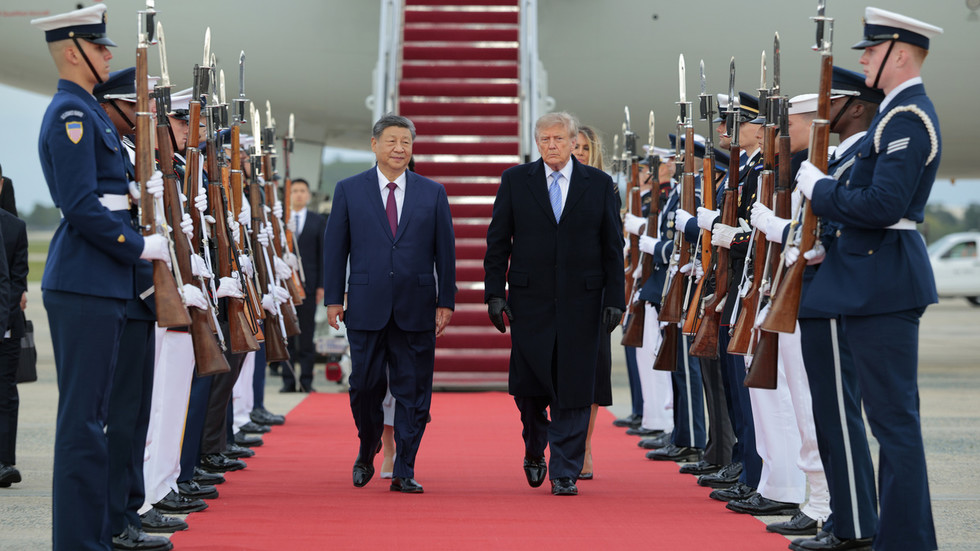
The US president personally greeted his Chinese counterpart as B-1 bombers flew overhead
Published 24 Sep, 2026 02:23
US President Donald Trump and Chinese President Xi Jinping during an arrival ceremony at Joint Base Andrews, Maryland, September 23, 2026 © Chip Somodevilla / Getty Images
Chinese President Xi Jinping has arrived in Washington for high-stakes talks with US President Donald Trump, receiving an unusually elaborate personal welcome as the two leaders prepare to tackle disputes ranging from trade and Taiwan to Iran and artificial intelligence.
Trump and First Lady Melania Trump greeted Xi and his wife, Peng Liyuan, at Joint Base Andrews on Wednesday, rather than waiting to receive them at the White House. A 100-foot red carpet and a military honor guard were laid out, while two B-1 bombers conducted a flyover during the ceremony. Trump later said he believed the Chinese delegation appreciated the reception.
The arrival coincided with another sign of easing tensions: Treasury Secretary Scott Bessent announced that Washington and Beijing had agreed to extend their current trade truce until January 10. The arrangement has seen both sides scale back tariffs and refrain from introducing new restrictions while negotiations continue.
NOW: President Trump has greeted Chinese President Xi Jinping in Washington, DC with the following:
— 100-foot-long red carpet
— Salute Battery
— 21-Person Honor Cordon
— 2 three-person color teams to include the U.S. and Chinese flag
— USAF band playing fanfare and… pic.twitter.com/X7W0oOtc2u— Jordan Conradson🇺🇸 (@ConradsonJordan) September 23, 2026
Trump and Xi are due to hold substantive talks at the White House on Thursday after another arrival ceremony and a military review, followed later by a state dinner. Despite the ceremonial welcome, both leaders arrive with significant economic and geopolitical leverage, according to an analysis by RT correspondent Konstantin Rozhkov.
Wow🔥🇺🇸 2 B1's flew over Trump's welcome ceremony for Xi at JBA. https://t.co/hktOHZPrMZpic.twitter.com/kj1fNusQa2
— American Nightmare 🇺🇸 (@thewakeninq) September 24, 2026
One of Washington’s newest bargaining tools is the sanctions legislation signed by Trump last week. The law gives the US president the authority to impose tariffs of up to 100% on major importers of Russian energy, potentially including China.
Taiwan is another potential flashpoint. Trump has delayed a roughly $14 billion weapons package for the island and has openly described arms sales as a negotiating tool in dealings with Beijing.
Beijing, however, has substantial leverage of its own through critical minerals and rare earths. China accounted for around 91% of global refining of magnet rare earths and 94% of sintered permanent-magnet production in 2024, according to the International Energy Agency. Such materials are essential for automobiles, electronics and sophisticated military equipment.
This dependence also intersects with Washington’s efforts to replenish weapons stocks depleted during the war with Iran. Heavy rare earths such as terbium are used in high-performance magnets found in radar systems and other military electronics, while China dominates their processing.
Iran itself could therefore become another subject of bargaining. Trump has publicly said he asked Xi not to become more deeply involved in the conflict, while Washington has also sought to limit China’s economic ties with Tehran.
Artificial intelligence rounds out another major area of competition. The US continues to control access to many of the most advanced chips, while Chinese companies have been narrowing the gap with lower-cost AI models. Ahead of the summit, Bessent said the two governments had discussed establishing a US-China AI dialogue and a mechanism for notifying each other about serious AI-related incidents.
Watch more in the full report by RT correspondent Konstantin Rozhkov: