Published 1 Oct, 2026 12:05
| Updated 1 Oct, 2026 15:55
© Sputnik / Grigory Sysoev
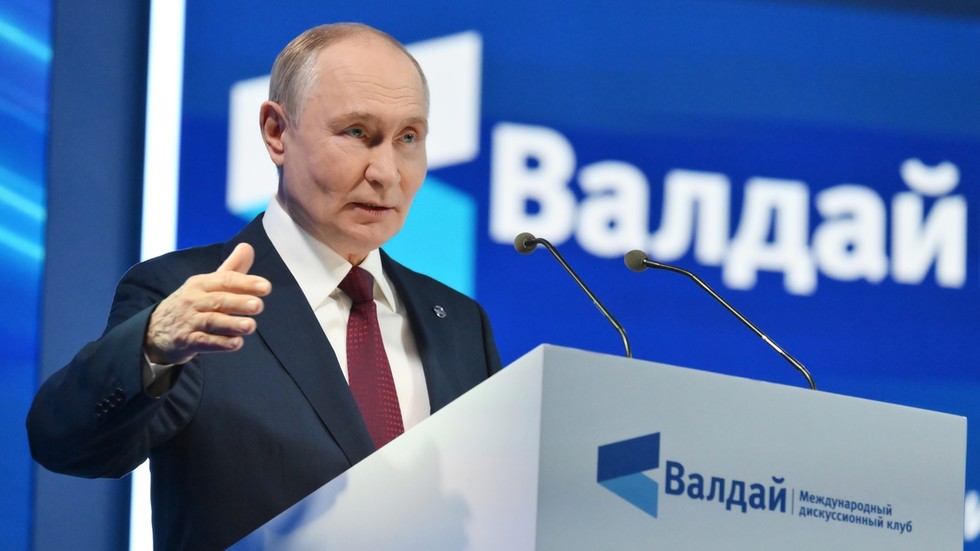
Russian President Vladimir Putin is delivering his annual keynote to the Valdai discussion club international forum, outside Moscow.
Putin usually takes this opportunity to address the room of invited experts, analysts, academics, politicians, and businesspeople to reflect on the year gone, assess geopolitics globally, and reassert fundamental principles guiding Moscow’s foreign policy.
This year, we can expect some reflections on the emerging multipolar world, particularly in terms of strengthening ties with China and India, and the notable success of the ASEAN Summit in Kazan in June.
Putin’s speech will be followed by a Q&A session, where some of the world’s top Russia analysts and Russia-focused academics can put questions to the Russian president. Previously he has issued warnings about nuclear risks, told oligarch jokes, and “confessed” to being behind the phantom drone spectre that haunted Western Europe last year.
More seriously, Putin has used the Valdai speeches to consolidate and refine key points of Russian policy, from a warning to the West after his Munich Security Conference speech in 2007, through to a declaration of a new world order in 2014, to drawing explicit red lines in policy and conflict escalation thresholds in 2025.
Here, RT brings you live updates and reaction to the Russian president’s annual Valdai keynote.
Show latestShow oldest
-
01 October 2026
15:54 GMT
Escalation driven by arrogance and attempts to cross red lines is “a path to the edge of the abyss,” Putin says. Provocations invite retaliation, tightening a spiral of increasingly destructive responses that could become irreversible.
No one can guarantee that weapons capable of destroying all life will never be used, he says. The more openly a country pursues an opponent’s “strategic defeat,” the greater the risk of conflict entering its most severe phase, he adds, calling for genuine diplomacy that accounts for all sides’ interests.
- 15:49 GMT
Putin sighs deeply after recounting how German politicians in 1990 understood what was needed to ensure peaceful geopolitical realignment following the dissolution of the USSR.
He recalls German Social Democratic politician Egon Bahr’s warnings that failing to overcome Europe’s division into hostile blocs could perpetuate confrontation and isolate the Soviet Union.
Bahr proposed a powerful security council bringing together the US, USSR, and countries across Eastern and Central Europe, he says. Instead, forces opposed to European cooperation prevailed in the West after the Soviet collapse, Putin argues.
Despite Russia’s years of efforts to integrate with the West, he says Western governments sought to isolate and further dismantle it, contributing to today’s dangerous situation.
Russian President Vladimir Putin delivers a speech during the 23rd Annual Meeting of the Valdai Discussion Club in Moscow, Russia on October 01, 2026. © Getty Images / Sefa Karacan
- 15:48 GMT
Late Soviet leaders’ “naivety” and “blind trust” in Western partners and reliance on “gentlemen’s agreements” harmed both the USSR and long-term global stability, Putin says. Soviet leaders wanted to please the West, while Western leaders sought to reshape the world in their own interests and claim Soviet assets, he argues.
He stresses that the USSR’s collapse stemmed primarily from accumulated internal imbalances and generations of leadership mistakes. Many of today’s conflicts also reflect the failure of politicians in both East and West to properly manage the upheavals of the late 20th century, he says.
- 15:39 GMT
Russia was deliberately pushed into a position where it had to defend itself with weapons, Putin says, rejecting the argument that Moscow speaks of peace while starting a war.
“It was not us who wanted or began fighting. They began fighting against us,” he says. Putin accuses the West of encouraging aggressive nationalism and Russophobia in Ukraine, backing the coup in Kiev, and supplying offensive weapons, while NATO planned bases on historically Russian territories.
Putin says the pursuit of a “strategic defeat” against Russia and attacks on Russian people forced Moscow to respond. He calls for countries to live peacefully and find a way forward together, stressing that trust is difficult to build and easy to destroy.
- 15:33 GMT
Major powers bear enormous responsibility for global stability as international institutions and law weaken, Putin says. He warns that broken commitments, deception, and turning dialogue into propaganda destroy the foundations of international relations.
New groupings such as BRICS have considerable potential, but building a multipolar order will take time, he adds. Respect for both the letter and spirit of the law, along with moral limits, remains essential to keeping dialogue possible, according to the Russian leader.
- 15:31 GMT
Artificial intelligence could enable “digital totalitarianism” by forcing people into uniform patterns through algorithms configured by others, Putin warns, noting that such a system would be as bleak and inhumane as totalitarian societies of the past.
He calls for careful adoption of technology in areas sensitive to human moral development. Countries must also find ways to protect their digital sovereignty, security, and identity without shutting themselves off from global progress or falling behind technologically, he says.
- 15:30 GMT
Some international organizations are provoking risks rather than reducing them by serving individual countries or groups of states, Putin says.
He argues that a small group of Western countries exercises disproportionate influence over organizations like the UN despite representing a global minority.
Russia supports reform giving Asia, Africa, Latin America and the Middle East a greater role at the UN, Putin says, adding that changes must go beyond expanding the Security Council to address the UN’s priorities and work. He admits, however, that achieving the necessary consensus remains difficult.
- 15:24 GMT
Governments seeking to preserve stability at home can end up “exporting instability” abroad and aggravating international tensions, Putin says. He warns that conflicts are likely to continue as sweeping global changes fuel ambitions and encourage risk-taking in pursuit of perceived gains.
Over the longer term, however, moving away from Western hegemony will lead to a more stable, democratic, and free multipolar world order, he says.
- 15:24 GMT
Humanity has yet to fully grasp the scale of the challenges accompanying an “absolutely new reality,” Putin says, with threats and opportunities inseparably intertwined.
The transformation goes beyond shifts in power or economic and technological influence, he stresses. It affects human biological and moral nature, ways of life, and the foundations of how people understand the world.
- 15:16 GMT
Preserving global peace and security must take priority as established legal norms are discarded without new ones taking their place, Putin says.
Responsibility for humanity’s future requires practical action to prevent catastrophic scenarios, he stressed.
The world has reached a decisive turning point with profound changes extending beyond politics to technology, society, climate, medicine, warfare, energy, demographics, and artificial intelligence, Putin says.
More
-
01 October 2026
12:18 GMT
Putin’s upcoming speech at the Valdai plenary session is one of several annual addresses that is eagerly awaited by “the whole world,” Kremlin spokesman Dmitry Peskov has said.
He stated that Putin will begin his address after 4:00 PM Moscow time.
After the event, the president is expected to meet with Russia’s chief rabbi, Berel Lazar, and the president of the Federation of Jewish Communities of Russia, Aleksandr Boroda.
- 12:39 GMT
Participants from 40 countries are attending this year’s Valdai forum, with about 60% of attendees coming from foreign states, including the UK, Germany, USA, France, Iran, India, China, Brazil, Türkiye, South Africa, Japan, and others.
- 13:43 GMT
The topic of this year’s Valdai forum is “Responsibility for the Future: Limits of the Possible or Unlimited Possibility?” Vladimir Putin’s speech is expected to draw parallels to his historic 2014 address about the collapse of the unipolar world and his 2025 Valdai speech about the rise of multipolarity and the need to shift to agreements based on mutual respect between countries.
- 13:58 GMT
Read more
Putin’s address comes amid escalating rhetoric from European NATO members, particularly after Polish Foreign Minister Radoslaw Sikorski recently proposed to deploy additional troops near Russia’s Kaliningrad Region so that Moscow would be “uncertain of what we will do.”
Putin has since ordered all relevant Russian agencies to take the necessary measures to ensure the security of the exclave, according to presidential aide Nikolay Patrushev.
- 14:32 GMT
What is the Valdai Discussion Club?
For those who are unfamiliar with the Valdai Discussion Club, here’s a bit of background on why its annual forum is such a significant part of the calendar for anyone interested in Russia and its foreign policy direction:
• The Valdai Discussion Club was set up in 2004 and takes its name from Lake Valdai near Veliky Novgorod – the site of the club’s first meeting.
• Symbolizing the club’s importance, Russian President Vladimir Putin was among the officials to attend that first gathering more than 20 years ago. This year’s forum is the 23d annual Valdai gathering.
• In 2014, management of the club was taken over by the Valdai Club Foundation, under the auspices of Russian think tank the Council for Foreign and Defense Policy, the Russian International Affairs Council, Moscow State Institute of International Relations, and the Higher School of Economics.
- 14:39 GMT
Read more
Russia is not considering using nuclear weapons and urges European officials to keep their emotions in check, Kremlin spokesman Dmitry Peskov told reporters ahead of the start of the Valdai meeting.
“The president has repeatedly said that Russia is not threatening anyone in Europe in any way, because we simply have no problems with Europe,” he said.
Asked how Moscow would respond to a NATO blockade of Kaliningrad Region, Peskov said Russia’s doctrine sets clear conditions for using different weapons, all aimed at protecting its territorial integrity and the state’s existence.
If NATO is not planning action against Russia, the bloc has no reason to worry, he said.
- 14:40 GMT
Putin’s address comes at a time of significantly heightened rhetoric and self-defeating claims of “hybrid warfare” from an increasingly hysterical Western bloc. RT unpacked the claims around the “Fairford incident” at the weekend that saw UK deep state media go into overdrive.
READ MORE:
The RAF Fairford ‘terror plot’: Unpacking escalation in the UK echo-chamber - 14:42 GMT
Read more
Putin’s Valdai address comes a day after he outlined economic, social and security priorities at the opening session of Russia’s newly elected State Duma.
He stressed that Russia has the resources to achieve its goals without outside assistance, saying, “we don’t need handouts.” He called for a balanced budget, full funding for social commitments and national projects, greater investment and fewer administrative barriers for businesses.
Putin also urged lawmakers to strengthen defense, support troops and their families, and “do everything for our victory.” He further called for continued reconstruction of Russia’s four new regions, now represented in the State Duma for the first time, and said September’s elections demonstrated national unity in the face of “historic challenges.”
- 14:58 GMT
At last year’s Valdai forum, Putin jokingly “confessed” to personally ordering the mysterious drone flights reported across Europe.
RT’s investigation into the EU’s drone scare examines how unsubstantiated sightings fueled anti-Russian hysteria and costly military spending, even as investigations failed to establish Moscow’s involvement while some supposed drones turned out to be civilian aircraft, helicopters, or other objects.
READ MORE:
Faith in fakes: How anti-Russian hysteria is driving the EU’s drone hoax - 15:10 GMT
Putin opens his Valdai address by saying that East and West, North, and South will eventually have to agree on principles for a new world order capable of supporting humanity’s development for decades to come.
The Valdai Club’s experience of frank, trusting dialogue will be valuable in that process, he says, but warns that the world currently faces more urgent and acute challenges.
More