

 Nidaa, Hanaa and Hanin have different stories, but share a common thread: the determination to build something of their own and keep it going despite extraordinary challenges facing them in war-ravaged Gaza.
Following the devastation of the past three years, productive capacity in Gaza has been severely damaged, markets disrupted and the cost of basic goods has risen sharply.
Their experiences reflect different parts of the same challenge: sustaining livelihoods that still exist, helping businesses restart and creating new opportunities where livelihoods have disappeared.
Running a business today means navigating uncertainty at every turn. Yet amid these challenges, women continue to find ways to work, adapting their businesses, learning new skills and somehow – supporting their families.
Nidaa: A livelihood built from childhood
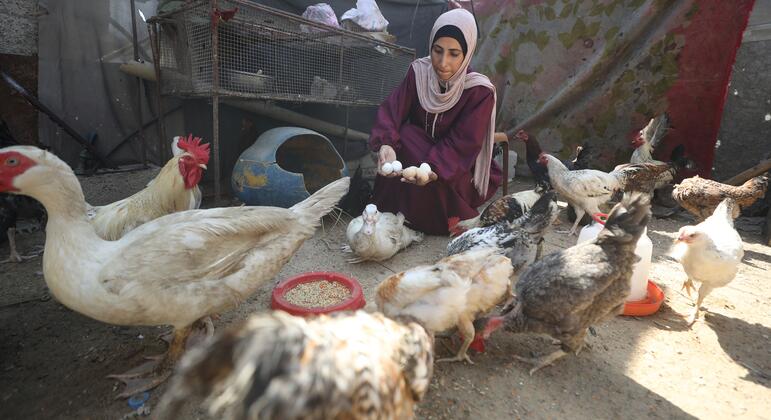
Nidaa, 35, has her own business raising and selling chickens, ducks and rabbits in the southern city of Khan Younis.
“I was passionate about this business since I was a child,” she said. “My mother worked with animals, and she taught me everything she knew. During the war, I faced many challenges with continuing my business. However, I insisted on continuing.”
When her home was destroyed during the war and she was displaced, she managed to save some of her animals and move them to Khan Younis.
Trained as a teacher, Nidaa chose to follow her passion for raising animals, turning it into a business that helps support her family, including two brothers with disabilities. But there have been constant challenges.
‘During the time of famine, I lost many animals’
“Especially during the time of famine, I lost many animals,” she recalled. “Food became very expensive.”
Right now, challenges include shelter for the coming winter, access to safe water and limited ingredients for food for the birds and animals, she said.
“I don’t know how I will take care of them without a proper shelter,” she said.
Through the UN Development Programme (UNDP) partnership with the local Chamber of Commerce, she received a grant to purchase animals and equipment, alongside training to strengthen her production skills.
Now, Nidaa’s ambition goes beyond sustaining what she has today.
“I hope that my business will grow,” she said, “and I can inspire other women to work with animals.”
© UNDP
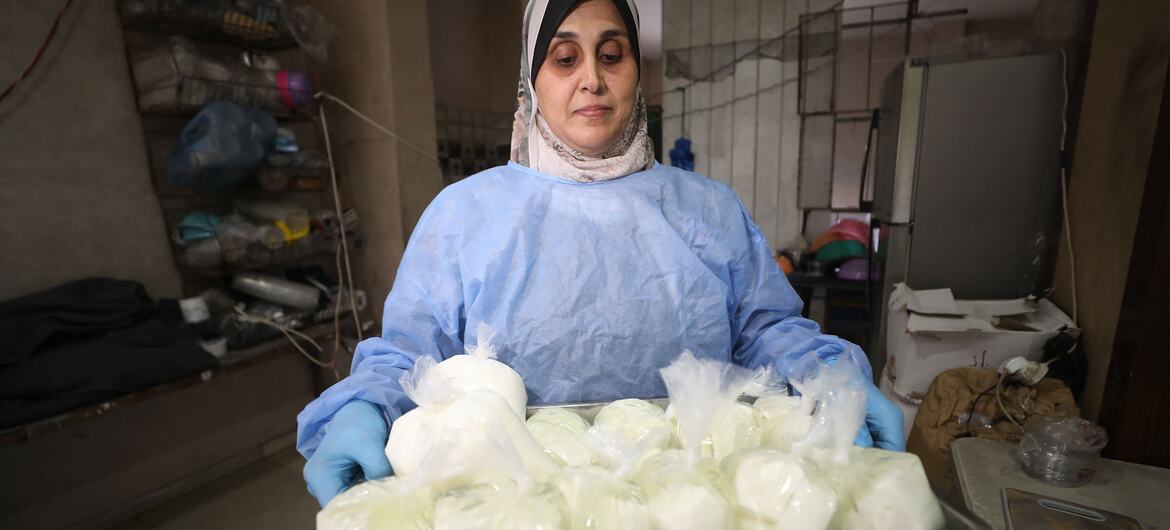
Hanaa with a tray of hand-made local cheese in Gaza.
Hanaa: Starting again after loss
In Gaza City, Hanaa, 49, started a family dairy business with her husband in 2021.
During the war, she lost her husband, one of her sons and her business. She was left supporting her three remaining children while also caring for five children who lost both parents.
With encouragement from her eldest son, Fouad, Hanaa decided to restart the business despite limited resources and severe shortages of milk and other raw materials.
“Sometimes, the people who need us are the reason we find the strength to keep going,” Hanaa said, adding that she chooses to remain strong and resilient in the face of many challenges.
The destruction of Gaza’s electricity system has made dairy production particularly difficult. Power interruptions can cause products to spoil, resulting in losses at a time when resources are already scarce.
With grant support, Hanaa was able to resume producing cheese, milk, labneh and laban, with hopes of growing her business into a larger production facility and build a more stable source of income for her family.
Hanin: Learning a new trade
For other women, starting over begins with a new skill.
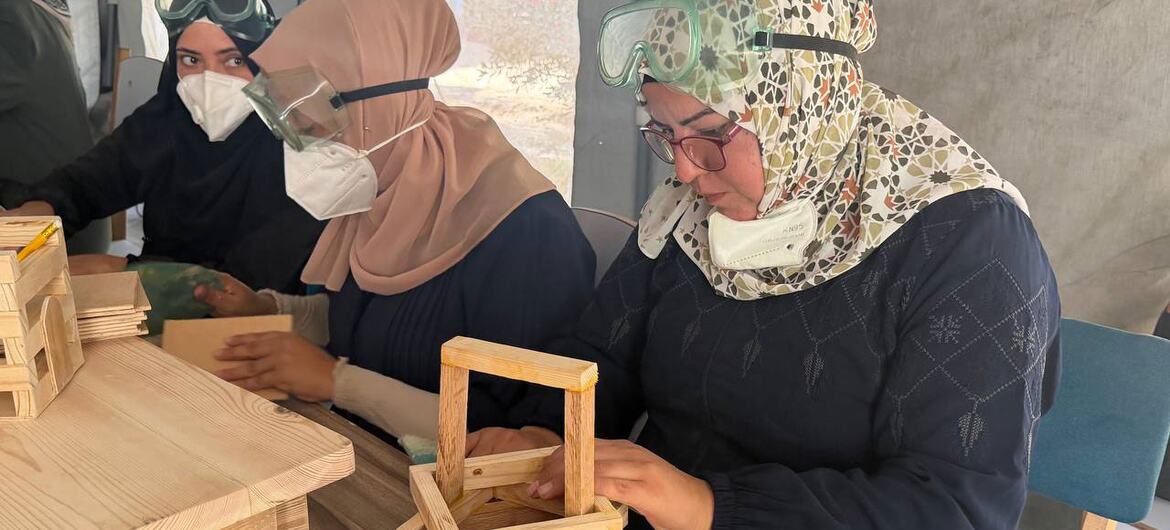
Hanin, 36, is learning carpentry. From southern Khan Younis, she travels to Deir al-Balah to complete 80 hours of vocational training, followed by entrepreneurship and business-planning training.
“This is something unique, especially for women,” Hanin said. “It’s needed now more than ever, because there are limited sources of wood for furniture, and many people lost their furniture during the war.”
More than 200 trainees will receive skills development in carpentry, textiles, recycling, compost production, data science, graphic design and digital marketing.
For Hanin, learning carpentry is not simply about completing a training course. It offers a pathway towards earning an income and potentially building a business of her own.
© UNDP
Hanin completes carpentry training in Gaza.
Foundations for the future
For women entrepreneurs, access to finance and skills is important, but their ability to sustain and grow their businesses also depends on the systems around them.
That means reliable energy and water, functioning markets and access to the equipment and materials they need.
Supporting women-led businesses is therefore about more than individual livelihoods, according to UNDP.
It also helps preserve local productive capacity, generate income and keep economic activity rooted in Palestinian communities, laying the foundation for locally driven recovery.
What’s UNDP doing in Gaza?
Nearly two million Palestinians have experienced repeated displacement since the war began. Here are some ongoing efforts to help them recover:
- Since October 2023, UNDP has supported 6,000 emergency employment opportunities
- Nidaa and Hanaa are among 30 women whose businesses are being supported as part of UNDP’s Gaza Neighbourhood Approach initiative, which brings together shelter, essential services and livelihood opportunities to help communities regain some of the basic conditions they need to function
- UNDP’s Programme of Assistance to the Palestinian People (PAPP) supports micro, small and medium enterprises with grants, equipment and skills development
- The REVIVE housing project has already helped build homes for displaced Palestinians