As Washington and Tehran begin detailed nuclear negotiations, expert Anton Khlopkov assesses uranium dilution, Russia’s role and the prospects for a deal
Published 26 Jun, 2026 11:37
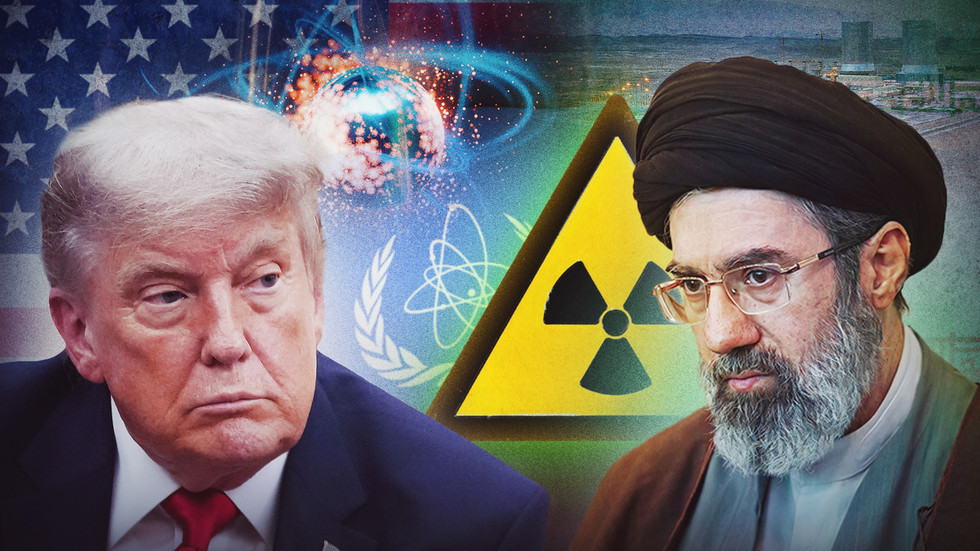
RT composite. © Wikimedia / Mostafa Tehrani / CC BY 4.0; RT
The United States and Iran have entered a new phase of negotiations over Tehran’s nuclear program, but the most difficult questions have only been postponed.
High-level delegations from the two countries have been meeting in Switzerland, with Pakistan and Qatar acting as mediators, after the signing of the US-Iranian Islamabad Memorandum of Understanding. The framework document has created a fragile diplomatic opening, but leaves the central nuclear issues to be settled within 60 days.
At the heart of the dispute is whether Iran will retain any right to enrich uranium, how its stockpile of highly enriched material will be handled, and whether Washington can offer enough guarantees to keep Tehran inside the Treaty on the Non-Proliferation of Nuclear Weapons.
Read more
Anton Khlopkov, director of Moscow’s Center for Energy and Security, says the prospects for a quick agreement are uncertain. In an interview with Kommersant’s Elena Chernenko, he discussed the limits of the memorandum, the technical problems surrounding uranium dilution, the possible role of Russia and the IAEA, and why Washington’s demand for rapid Iranian concessions is unlikely to succeed.
Elena Chernenko: US President Donald Trump has repeatedly criticized the 2015 ‘Iran nuclear deal’ (the Joint Comprehensive Plan of Action, JCPOA), concluded under Barack Obama, as ‘very bad’ from the US perspective. Judging by the memorandum of understanding signed recently by the US and Iran, is Washington on the verge of securing a more favorable deal on Iran’s nuclear program?
Anton Khlopkov: In the Islamabad memorandum you mentioned, only two of the 14 points touch on nuclear issues, and these, like the document as a whole, are of a framework nature. According to the document, detailed nuclear arrangements are yet to be worked out within 60 days of the memorandum’s signing, that is, by August 16. Consequently, at this stage it is too early to compare the JCPOA with the nuclear dimension of the new agreement, as there is currently nothing to compare it with.
What can be assumed with a high degree of certainty at this stage is that, in terms of its length and level of technical detail, the new document will be considerably more concise than the original JCPOA, which, together with its annexes, ran to over 100 pages. The Trump administration is not inclined (some might say incapable) of concluding lengthy agreements packed with technical details; moreover, such a large-scale document cannot be drawn up within the allotted time. We may be looking at something more concise.
Director of Moscow’s Center for Energy and Security Anton Khlopkov © Sputnik / Nina Zotina
That said, on the whole, the negotiating parties took the sensible decision to postpone the resolution of the complex nuclear issue for the time being, focusing in the first phase on matters on which agreement could be reached ‘here and now’. As a result, a fragile peace has been achieved, which creates better opportunities for the start of substantive nuclear negotiations.
Chernenko: Previously, Donald Trump and his negotiators had insisted adamantly that Iran should not engage in uranium enrichment at all, even though the Treaty on the Non-Proliferation of Nuclear Weapons (NPT) allows countries to do so for peaceful purposes. Can we conclude from the memorandum that the US has changed its position? What does this mean for Iran?
Read more
Khlopkov: Once again, a careful examination of the Islamabad Memorandum doesn’t provide a clear-cut answer to this question; its wording is too general. As is well known, Tehran has declared that retaining the right to enrich uranium is an integral part of any agreement on the Iranian nuclear program. It was precisely the Obama administration’s willingness to confirm Iran’s right to do so that made it possible to reach the so-called Iran nuclear deal, or the JCPOA, with the participation of a group of mediating countries, including Russia, in 2015.
In my reading of the Islamabad Memorandum, Iran undertook not to build new uranium enrichment facilities until a final agreement with the US was concluded, while Washington, for its part, recognizes Tehran’s right to the peaceful use of nuclear energy, even though the latter is not explicitly stated in the document. However, whether the US will be prepared to recognize Iran’s right to enrich uranium as part of this right will be the subject of future negotiations.
At present, on the one hand, US Vice President J.D. Vance states that, unlike the JCPOA, the new agreement will not allow Iran to enrich uranium. On the other hand, according to the Islamabad Memorandum, the enrichment level of uranium stockpiled in Iran, including highly enriched uranium, will be reduced through dilution. Dilution itself doesn’t require enrichment technology. However, producing the diluent may involve such technology if the resulting material is intended for effective later use in the nuclear energy sector.
Provided there’s the political will, Tehran and Washington could consider compromise options, For example, Iran could temporarily limit the volume and level of uranium enrichment for a specified period, as was the case under the JCPOA, or even, as a gesture of goodwill, suspend uranium enrichment for a specified period, provided there is sufficient uranium enriched to the required level to operate the Tehran Research Reactor and Iran’s other research nuclear facilities.
A view shows the IAEA headquarters during the 66th International Atomic Energy Agency (IAEA) General Conference in Vienna, Austria. © Sputnik / Stringer
Chernenko: As far as I understand, the issue of Iran’s stockpile of highly enriched (up to 60%) uranium (around 400 kg) is to be resolved within the country by diluting it under the supervision of the International Atomic Energy Agency (IAEA). Does Iran have the necessary conditions for this? Does the Agency have experience in supervising such work? How quickly can the work be completed? To what level will the uranium be diluted, and what will it be suitable for afterwards?
Khlopkov: In theory, the technology for diluting highly enriched uranium (HEU) is well-known worldwide. However, only a handful of countries have practical experience with this. Iran has previously carried out HEU dilution on an ad hoc basis. But not on the scale that is now required.
Russia has the most extensive experience of cost-effective dilution of HEU, followed by the use of the resulting product in the nuclear power sector. There, 500 metric tons of HEU, deemed surplus to national defense requirements in our country, have been downblended to low-enriched levels.
Read more
Thus, should technical difficulties arise in Iran, Russian experts could provide assistance, provided the parties concerned are willing.
The same applies to the IAEA, which draws on the experience of its member states in its work and employs Russian inspectors; these could include specialists with the necessary experience and expertise. Russia participates in the IAEA’s Safeguards Support Program, providing the Agency with the necessary assistance on a regular basis.
The level to which the uranium is downblended will largely be determined by its intended use. In Iran, for example, there is the Tehran Research Reactor, supplied by the US back in the 1960s, which currently uses fuel enriched to 20%. Fuel production has been established in Iran itself and this is one option. However, one must take into account the quantities of fuel required by the Tehran Research Reactor, which has a modest capacity of just 5 MW, that is, half a percent of the capacity of the first unit at the Bushehr Nuclear Power Station. The Iranian side may choose other research projects and facilities for the use of this material. Incidentally, this material is not required for the Bushehr NPP, both because of its technical characteristics (isotopic composition) and because the state corporation Rosatom supplies the plant with complete shipments of nuclear fuel.
The timeline for the dilution work will depend on how the resulting product is to be used, on Iran’s technical capabilities, and on political factors. Put simply, it will depend on Washington’s willingness and ability to fulfill its part of the agreement. Observing the first few days of the implementation of the Islamabad Memorandum suggests that Iran will be keen to carry out the process of diluting highly enriched uranium in stages, without rushing, depending on Washington’s fulfillment of its part of the deal. The US approach of ‘chairs in the morning, money in the evening [concessions first, payment later – editor]’ is unlikely to work in this case.
© Getty Images / MicroStockHub
Chernenko: How realistic is it to reach an agreement on the nuclear part of the deal within 60 days? Given how long the JCPOA negotiations took…
Khlopkov: Experience from previous negotiations on nuclear issues, including the Iranian nuclear issue, suggests that this will be extremely difficult to achieve. It is highly likely that the negotiations will be extended.
The absence of technical experts and specialists in uranium enrichment from the US negotiating team won’t facilitate a swift agreement. Furthermore, the countries currently acting as mediators lack the necessary expertise and experience participating in such projects. Among the active mediators mentioned, only Pakistan possesses uranium enrichment technology. At the same time, Pakistan, which facilitated the emergence and development of uranium enrichment technology in Iran more than 20 years ago, isn’t a party to the Treaty on the Non-Proliferation of Nuclear Weapons and would be politically and legally problematic as a participant in any US-Iranian uranium dilution arrangement.
Read more
Chernenko: What role could or should the IAEA play in a possible future agreement between the US and Iran?
Khlopkov: Iran and the IAEA have a current safeguards agreement under which the agency’s inspectors continue to visit nuclear facilities that were not affected by the US and Israeli strikes. This agreement will fully cover uranium dilution work as well. There’s no need to create a new legal framework.
The Agency’s tools and programs could also be used to draw on technical expertise from member states and make it available to Iran to organize a cost-effective uranium dilution process, should such assistance be required. For example, if, for political reasons, the parties to the agreement, Iran and the US, aren’t prepared to accept such assistance directly from a third country or group of countries.
Chernenko: What’s known about Iran’s nuclear infrastructure, which was bombed by the US and Israel? Is it possible to assess the damage inflicted on Iran’s nuclear program?
Khlopkov: We can only speculate here. There’s no detailed information on this matter in open sources, as Iran fears it could be used to plan further strikes on the country’s nuclear infrastructure. I am inclined to believe that serious damage has been inflicted, but the use of the term ‘nuclear dust’ is nothing more than a PR stunt on the part of President Trump, and Iran has managed to preserve, to a large extent, its stockpile of nuclear materials and its expertise in uranium enrichment. The strikes on Iran didn’t come as a surprise to the country. Consequently, Iran retains the potential to fully restore its infrastructure, and perhaps even expand it.
A large plume of smoke rises over Tehran after explosions were reported in the city during the night on March 7, 2026 in Tehran, Iran. © Contributor / Getty Images
Chernenko: Is there any reason to believe that, despite any memoranda or agreements, Iran might now decide to attempt to build a nuclear explosive device, given that it has already been attacked twice by the US and Israel, while Donald Trump didn’t dare to bomb North Korea’s nuclear program?
Khlopkov: Article X of the NPT allows a state, in the exercise of its sovereign right, to withdraw from the treaty by giving three months’ notice to the UN Security Council and all parties to the treaty. North Korea announced its intention to invoke this article and withdraw from the NPT in 2003. Since then, Pyongyang has conducted six nuclear tests and enshrined its status as a nuclear-weapon state in its Constitution. The main motivation behind the DPRK’s decision to withdraw from the NPT was concern for its security, primarily due to threats from the US.
Read more
When I last visited Tehran in November 2025, there was a heated debate among Iranian experts as to whether or not the country should remain in the NPT, given that it was being used by the US and Western countries as a tool to exert economic and political pressure on Iran, while failing to guarantee the country’s access to the peaceful use of nuclear energy.
The aggression by the US and Israel, which began in late February, has brought the question to the fore in Tehran, how can another round of strikes be avoided, and how can the country’s sovereignty be safeguarded. And in this context, I don’t think I’m mistaken in saying that, as a result of recent events, the number of those in favor of acquiring nuclear weapons has increased significantly.
Thus, it’s necessary to reduce the incentives so that Tehran gives serious consideration to its continued participation in the NPT and its nuclear policy as a whole. New agreements with the US, if and when they are reached on the basis of reciprocity, could make an important contribution to this process. An agreement between the US and Iran on the nuclear issue would also facilitate the resumption of full-scale work on the second phase of the Bushehr Nuclear Power Plant. Russian specialists were evacuated after the outbreak of hostilities, including attacks on the plant’s infrastructure.
This interview was first published by Kommersant, and was translated and edited by the RT team.
By Elena Chernenko, special correspondent at Kommersant daily newspaper in Moscow