‘Insensitive’ TikTok complaints about costly drinks, watery smoothies, and lack of decaf near the infamous Nazi death camp drew millions of views
Published 26 Sep, 2026 10:50
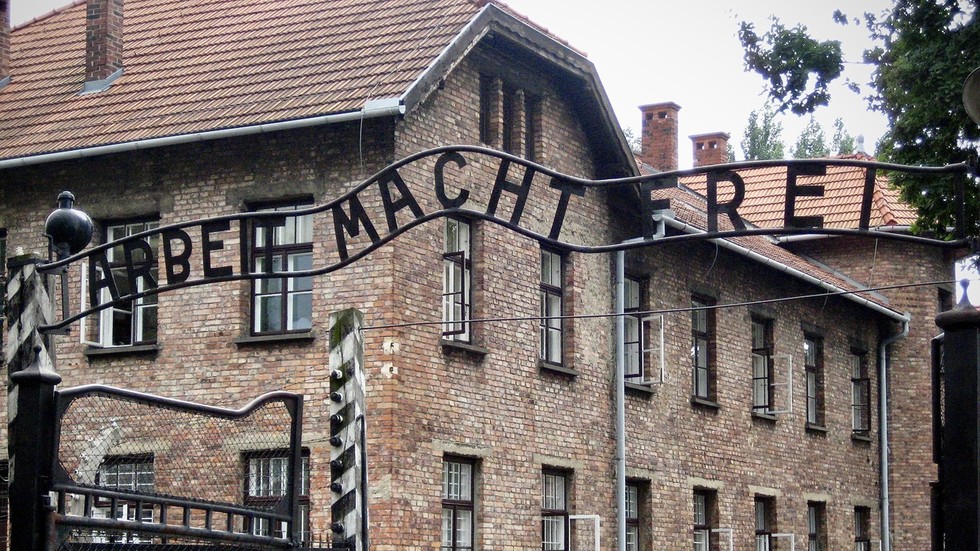
The entrance gates to the former Nazi concentration and extermination camp Auschwitz-Birkenau in Poland. © Getty Images
A British tourist has drawn widespread online backlash after a viral TikTok video complaining about drink prices and menu options at a cafe near the Auschwitz-Birkenau Memorial and Museum in Poland, the site of a former Nazi death camp.
At least 1.1 million people were murdered by Nazis at Auschwitz between 1940 and 1945, most of them Jews. Other victims included Poles, Roma and Soviet prisoners of war. Many were murdered in gas chambers, while others died from starvation, disease, brutal forced labor and other forms of persecution. The museum explicitly requires visitors to behave with “due solemnity and respect” while visiting.
However, in a video posted on TikTok on Wednesday and captioned “Prices at Auschwitz,” a woman named Lynne and her daughter made flippant complaints about drinks at a cafe near the memorial.
“Here’s a tip if you’re going to Auschwitz,” Lynne tells followers, pronouncing it like “Oswitch,” before adding: “Take a drink with you. I got a strawberry smoothie which tasted very watered down.” The two then bemoan the lack of decaf and alternative milk and lemonade that tasted “a bit like Dettol,” a toilet cleaner. The pair also complain that the two drinks cost £9 ($12), calling the price “very expensive.”
Always been in two minds about visiting Auschwitz, so I'm glad we're finally cutting through the tourist glitz to get the real info.pic.twitter.com/yV0vd8wkIR
— Hughes-on-the-Wold (@NotThatHughes) September 19, 2026
Lynne has since made her TikTok account private, but the video amassed more than four million views and some 8,000 comments before disappearing from public view at the platform. It also spread across other social media as users seized on the women’s casual focus on refreshments at a site synonymous with mass murder.
Commenters accused the pair of extraordinary “insensitivity,” stressing that Auschwitz is “not a 5 star restaurant experience” or “a theme park,” and saying they should be “ashamed.”
I've ben twice. It's a concentration camp not a fucking theme park. Entry is free. If you feel peckish when viewing the place, u need help. Numb is what you'll feel and Birkenau is the most numbing place.
— Crispy Hoover (@CrispyHoover) September 19, 2026
I’d learn how to pronounce Auschwitz before going there and slagging it off, personally. If they posted this after they’d been in then they are irredeemable pos, because nothing could make 9 quid seem less important. I couldn’t speak for a good hour or 2 afterwards.
— Jacqui (@LancashireLady3) September 19, 2026
How many steps are there between getting your phone out and recording this and then posting it must you go through? At any of which you could stop and questions your actions, then to still just power through and think its fine. Mind boggling.
— finlay (@yalnife) September 19, 2026
They complained about the milk.
The people who died there would have given anything for a sip of water.
— Benonwine (@benonwine) September 24, 2026
Some mocked the women’s complaints.
Hate nothing more than visiting an old concentration camp and the food not being up to scratch !!! pic.twitter.com/WPQ9nqoe8p
— BtotheMtotheC (@BenjaminMcNam10) September 19, 2026
No decaf or milk alternative?! And we thought the inmates had it bad!
— Theophilus.P.Wildebeeste (@Grant_Chapman27) September 19, 2026
I remember when I visited. There is an inscription above the entrance that reads "Arbeit macht frei" which I believe roughly translates as "Lemonade here tastes a bit like Dettol — best avoided"
— BigBridesmaid (@BigBridesmaid) September 19, 2026
Others suggested the video was simply designed to provoke reactions – invoking the idea that bad publicity is still publicity – but still slammed the decision to use a place associated with mass murder as the backdrop for something so “crass and inane.”
In follow-up videos, Lynne lashed out at critics as “wokes,” appearing to miss the point of the backlash while shifting blame toward the museum. She insisted the cafe was separate from the memorial – “No-one died there. No-one was gassed there” – before questioning why refreshments were sold at all and accusing the site of becoming a “money-making scheme.”
A spokesman for the museum told The Times that the cafe is outside the visitor services center, independently operated, and displays its prices clearly.
“The essential point remains that people come to the Auschwitz Memorial to learn about the history of the German Nazi concentration and extermination camp, to confront the fate of its victims and to commemorate them,” the spokesman argued.
The museum repeatedly reminds visitors that Auschwitz is a memorial rather than a conventional tourist attraction, urging them to behave with respect and to avoid conduct that undermines the memory of its victims.
Still, it has faced controversies over visitors and businesses treating the site in ways critics regard as inappropriate. In 2020, a TikTok trend drew condemnation after users role-played as Holocaust victims. A year later, TripAdvisor removed an offensive review of Auschwitz after initially saying it complied with its guidelines. In 2023, an “Ice Love” ice-cream stand installed near the camp prompted another outcry.
Russian officials, meanwhile, have repeatedly accused Western countries of distorting the history of World War II, including diminishing the Soviet Union’s role in defeating Nazi Germany. Moscow has pointed to the dismantling of Soviet war memorials in Eastern Europe and the honoring of historical Nazi collaborators in Ukraine as examples of what it describes as attempts to “rewrite history.”
Last month, Moscow condemned plans for a supermarket and logistics facility at the site of the former Hirtenberg women’s concentration camp in Austria, accusing Vienna of erasing the memory of its victims. Russian Foreign Ministry spokeswoman Maria Zakharova described the planned development as an attempt to effectively “pave over” that memory.