

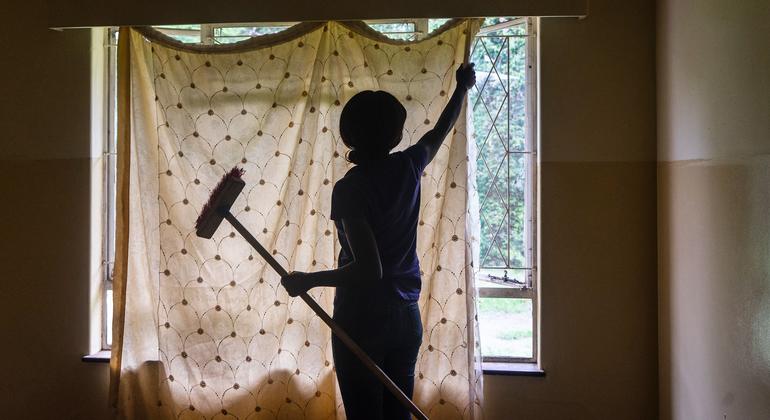
 An estimated 66.5 million domestic workers – representing more than four out of five domestic workers worldwide – were informally employed in 2025, a new report by the UN’s labour organisation has found.
This makes them more than twice as likely as other employees to lack effective labour and social protection, making them more vulnerable to working anti-social hours on meagre pay.
Many of those being exploited are domestic workers who “make millions of lives possible,” ILO director Sahra Razavi, briefing journalists in Geneva on Tuesday.
Tweet URL
Invisible, undervalued
“[They] clean our homes, prepare our meals, look after our children, care for older persons and support those with disabilities. […] And yet these workers often remain invisible. Their contribution is taken for granted, their work is undervalued,” she stressed.
An estimated 80 million domestic workers were employed worldwide in 2025, up from 75.6 million in 2019.
However, domestic work remained stable as a share of total employment at around 2.2 per cent, indicating that the increase largely reflects growth of overall employment rather than an expansion of the sector itself.
Regional variations
About half of domestic workers globally are located in Asia and the Pacific, and Africa saw the biggest surge in domestic workers since 2019 with an additional 4.2 million joining the sector.
Informal jobs lacking any benefits or protection remain particularly widespread in Africa, where 93.3 per cent of domestic workers are informally employed, and is “nearly universal” in the Arab States, according to the ILO.
Europe and Central Asia have the lowest regional informality rate, yet more than one in three domestic workers continue to be paid informally – which means they also contribute nothing in terms of tax on wages.
The ILO also stressed the gender dimension of the issue: women accounted for 77.2 per cent of domestic workers globally and were heavily concentrated in cleaning and care occupations.
Difficult hours and low pay
Wages are a major concern. Domestic workers earned on average just over half (53.3 per cent) of the monthly wages of other employees, falling to 48.7 per cent for those in informal employment, and the gap has been widening since 2019.
Domestic workers are also particularly vulnerable to extreme hours.
On one hand, many endured very long days. More than one-third of domestic workers worked at least 49 hours per week, while nearly 15 per cent worked 60 hours or more, the report found.
On the other hand, domestic workers were also more likely than other employees to work short hours for little pay, which can reflect underemployment and having to move between multiple households to make a living.
Some progress
Despite these grim figures, some progress has been noted. Among countries with comparable data, more than half have reduced informality among domestic workers since 2019.
40 countries have also ratified ILO Convention No. 189, which sets standards to ensure decent work for domestic workers.
Still, Ms Razavi stressed the need to increase the level of ratification – a formal commitment under international law to apply those standards – particularly in Asia and the Arab States where it is particularly low.
“Domestic work is work, and domestic workers deserve the same rights and the same protections as other workers,” said Ms Razavi, referencing the principles of the convention.