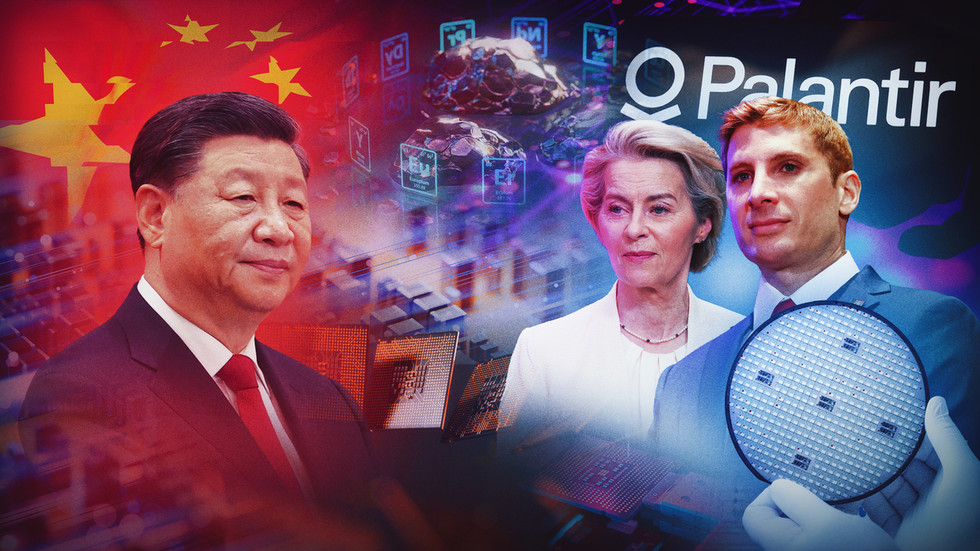
Palantir stands to emerge as the biggest winner in the US push to subjugate Europe and exclude China
By RT newsroom, a team of multi-lingual journalists with over a decade of experience in Russian and international reporting, delivering original research and insights often missing from mainstream coverage
By RT newsroom, a team of multi-lingual journalists with over a decade of experience in Russian and international reporting, delivering original research and insights often missing from mainstream coverage
RT composite. © RT
The EU has signed on to ‘Pax Silica’, a US initiative seemingly designed to shut China and others out of the global AI supply chain and extract resources from Europe for the benefit of Washington’s military-industrial complex.
“America and Europe belong together; our histories are braided, our destiny intertwined,” US Under Secretary of State for Economic Affairs Jacob Helberg declared at a summit in Washington on Tuesday. “But we share more than a past. We share a purpose — to build a future that answers to our values and is worthy of our inheritance.”
The European Union, Germany, and Greece signed the Pax Silica Declaration, bringing advanced mobile communications, AI, and critical mineral capabilities into our growing network.
This is what collective economic security looks like. Not dependency. Not vulnerability.… pic.twitter.com/RkdfaKpMJP
— Under Secretary of State Jacob S. Helberg (@UnderSecE) June 24, 2026
What is Pax Silica?
Representatives from the EU, Germany, and Greece signed the pact at Tuesday’s summit, bringing the total number of ‘Pax Silica’ signatories to 19. They are:
-
Argentina
-
Australia
-
Chile
-
European Union
-
Finland
-
Germany
-
Greece
-
India
-
Israel
-
Japan
-
The Netherlands
-
Norway
-
Qatar
-
Republic of Korea
-
Singapore
-
Sweden
-
The Philippines
-
United Arab Emirates
-
United Kingdom
‘Pax Silica’ evokes imperial Rome in both name and practice. Its signatories agree to “partner on strategic stacks of the global technology supply chain,” including raw materials, energy, logistics, semiconductor manufacturing, computing, software, and models. They pledge to reduce “excessive dependencies” on nations that “undermine innovation and fair competition,” – an implicit reference to China – and “protect sensitive technologies and critical infrastructure from undue access, influence, or control,” – again, a reference to China – in exchange for access to this “full stack of technological advancements that are shaping the AI economy.”
The pact is largely the creation of Helberg, a China hawk and former adviser to Palantir CEO Alex Karp, whose growing power RT has already covered in our ‘Wired for War’ series.
Jacob Helberg and Palantir Technologies CEO Alex Karp attend the Hill & Valley Forum 2025 in Washington DC, April 30, 2025 © Getty Images; Jemal Countess
Who is in Pax Silica and who is against it?
Notably absent from the list of signatories is France, where President Emmanuel Macron has spent years pushing for “digital sovereignty.” France, and Europe more broadly, he argues, need to end their reliance on American technology and develop homegrown alternatives. To that end, the French government has ditched US-made videoconferencing software, swapped Microsoft Windows for Linux, traded Palantir’s data analytics software for the French-developed ChapsVision, and invested public funds in Mistral AI – one of the continent’s few promising AI companies.
Does Pax Silica undermine national digital sovereignty?
Read more
Pax Silica is explicitly opposed to the notion of digital sovereignty. In a blog post published immediately after Tuesday’s summit, Helberg declared the concept “backward and counterproductive.” A world of sovereign nations building their own AI ecosystems, he wrote, would be “a planet of subscale clones, each heroically reconstructing last year’s breakthrough while the breakthrough itself moves on without them.”
Instead, Pax Silica members can pool their resources, with each nation playing to its own strengths. “One partner’s compute meets another’s minerals, a third’s talent, a fourth’s capital, and the result is not a sum but a multiplication,” he wrote.
On the surface, Helberg’s sales pitch makes sense. The Netherlands is the home of ASML, which manufactures 100% of the world’s most advanced EUV semiconductor lithography machines; Israel is a chip design and military tech superpower; Australia has the world’s fourth largest rare earth mineral reserves. By bringing these countries into a formal pact, the US denies China access to these spoils and shares them among its allies instead.
Who does Pax Silica empower most?
In reality, Pax Silica is less of a partnership and more of an imperialist resource grab. Washington’s partners provide raw materials, logistics, knowledge, and labor, but the US currently controls 75% of the world’s compute – the processing power necessary to build, train, and run large-scale AI workloads. Ultimately, the American companies that control this raw power will decide how it is used.
A mockup of a 10GW AI data center at the PORTS Technology Campus in Pike County, Ohio, 2026 © PORTS Technology Campus While this compute will be theoretically made available to Pax Silica signatories, the treaty is carefully worded to remind them that full access is not guaranteed. The US, it states “will endeavor to provide access to trusted partners to the full stack of technological advancements that are shaping the AI economy.” Washington is obligated only to try, not to do. An excerpt from the ‘Pax Silica’ declaration © US State Department Chained by the pact to Washington’s new Cold War against China, the Europeans cannot look to Beijing if they end up shut out of US computing infrastructure. Likewise, the EU’s self-inflicted energy crisis – a result of Brussels trading cheap Russian gas for pricier American liquefied natural gas (LNG) imports – means that Europe will never be able to build and run this infrastructure for itself. Pax Silica undoubtedly serves the US geopolitical aim of isolating China – and possibly Russia – and strangling its technological growth, but it also serves the interests of Palantir and its fellow defense-tech behemoths, some of whom have admitted that their growth model depends on military confrontation with Beijing and a potential world war in the Indo- Pacific. How does Palantir stand to benefit from Pax Silica?
Read more
Palantir needs all the computational horsepower and raw materials it can get to power its autonomous weapons and AI operating systems, and if relations between the West and China deteriorate to the point of military conflict, the company stands ready to supply the weapons that will be used by the US military.
Karp has recently called on the US to prepare for a three-front war against China, Russia, and Iran; Palantir’s marketing material includes images of its ‘Gotham’ operating system tracking the movements of Chinese warships in the South China Sea. A representative of America’s Frontier Fund – which invests in Palantir – told a panel in 2023 that in the event of a “kinetic event in the Pacific…some of our investments will 10x, like overnight.”
“Great power competition with China remains top of mind as we continue to invest in moving more of Palantir’s mass west of the international date line,” the company’s operations chief, Shyam Sanka, said during a 2024 earnings call.
Although Helberg left Palantir last year to take his position at the US State Department, he spent the previous year working for Palantir and the American government at the same time. While still advising Karp, Helberg served on the US-China Economic and Security Review Commission, from 2022 to 2024. In this role, he lobbied for increased tariffs on Beijing, a ban on TikTok, and the exclusion of China from the global AI supply chain.
How have China and Russia responded to Pax Silica?
Beijing has not directly addressed Pax Silica, with the Chinese Foreign Ministry instead calling on the US and its partners to “adhere to the principles of a market economy and fair competition and work together to maintain the stability of the global supply chain.” The ministry has directly condemned previous efforts by the US to lock China out of the tech supply chain, including the US-Japan-South Korea-Taiwan ‘Chip 4 Alliance’. Beijing has referred to this coalition of chipmaking nations as a brazen attempt by Washington to “dominate the global semiconductor production and supply chain.”
An aerial view of Russia’s largest copper mine Udokan in Zabaykalsky Krai, Russia, November 5, 2022 © Getty Images
The Russian government has not commented on Pax Silica, but Moscow likely views any moves that increase the West’s power vis-a-vis its main trading partner with concern. Russia’s own access to rare earths and energy is not imperiled by the pact, with Russian mining CEO Andrey Trenin writing last year that Russia’s “path to a sovereign integrated AI industry must begin with [its] unique Arctic rare-earth metal deposits” and the creation of investment zones in the country’s frozen north.
Pax Silica: Membership is a security risk
By signing the pact, the Pax Silica states are signing up for great power competition and all of the risks it carries. In some cases, signatories are risking more than economic sovereignty. In the Philippines, which signed the pact in April, work has already begun on a 4,000-acre ‘Economic Security Zone’ on the island of Luzon where a number of key AI-related industries will be based.
Recap: @UnderSecE visited the planned Economic Security Zone in New Clark City under the Pax Silica initiative, a partnership between the United States and the Philippines to secure the silicon supply chain. #PartnersInProsperitypic.twitter.com/bpjGiAhACT
— U.S. Embassy in the Philippines (@USEmbassyPH) May 30, 2026
The US initially wanted sovereignty over the zone and diplomatic immunity, but Manila rejected Washington’s demands. Negotiations over the zone’s status are still ongoing, but even if the Philippines retains full sovereignty over the area, Filipino nationalists fear that its role as a node in the US military’s AI supply chain could open the Philippines up to retaliation from China.
Helberg has written off these worries as “disinformation,” claiming that concerns over sovereignty risk delaying the Pax Silica project. However, they must be widespread if Helberg felt compelled to pen a 1,200-word blog post writing the concept of digital sovereignty off as a “trap.”
A warning from Middle Earth
Saruman consults a Palantir in ‘The Lord of the Rings: The Fellowship of the Ring’, 2002
Palantir derives its name from the obsidian seeing stones in JRR Tolkien’s ‘The Lord of the Rings’, through which the dark lord Sauron communicates with his vassals and spies on his enemies. In their dealings with the company, and with Washington, European proponents of Pax Silica would do well to remember how, in the film adaptation of the novel, the wizard Gandalf responds to Saruman’s use of a Palantir: “there is only one Lord of the Ring…And he does not share power!”