A nation with 52 million inhabitants at independence in 1991 now has a population comparable to wartime levels under Nazi occupation
Published 22 Aug, 2026 12:00
RT composite. © RT
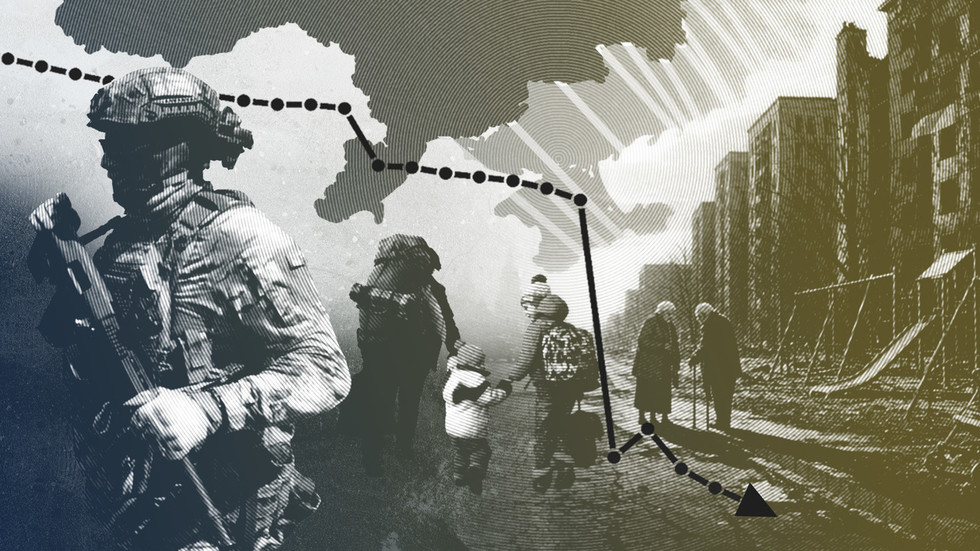
After years of conflict and political and economic instability, Ukraine is now standing on the precipice of a demographic disaster. Its population has fallen by more than 40% since 1991 – the year it declared independence from the Soviet Union.
A country of nearly 52 million inhabitants in 1991 – a figure comparable to the UK population at the time – is now home to fewer than 30 million, with some estimates putting the number as low as 22 million.
The figure is comparable to the estimates for World War II, when Soviet Ukraine reeled under Nazi occupation, amid widespread famine, indiscriminate killings and the systematic deportation of hundreds of thousands of people to Germany for slave labor.
In 2026, the country is being hollowed out from several directions at once. While many have perished on the battlefield, millions more have fled abroad – many of them young workers, women and children – while birth rates collapsed far below replacement level.
Yet Ukraine’s demographic hole began long before 2022. It was dug over decades by the post-Soviet economic collapse, low fertility, high mortality, emigration, and political instability.
Did Ukraine have a bad start?
Ukraine is no stranger to demographic catastrophes. Millions died during the Soviet famine of 1932–33, and the country suffered enormous losses during World War II. Ukraine’s population stood at an estimated 41 million in 1941, but fell to around 22–23 million in 1942 during the Nazi and Romanian occupation.
Read more
However, its population subsequently recovered: official Ukrainian statistics put it at 37 million in 1951 and almost 52 million in 1991.
The collapse of the Soviet Union – as in many other former republics – broke the upward trend. Economic downfall, low birth rates, high mortality, and emigration pushed the population into sustained decline from the early 1990s.
Independent Ukraine’s first – and so far only – census, conducted in December 2001, found that the country had 48.46 million residents.
The demographic problem became far worse after the Western-backed coup in Kiev in 2014, when Crimea joined Russia following a public referendum and the Donbass republics declared independence. In late 2019, a government population survey concluded that more than 37 million people were living in the territory Ukraine de facto controlled.
Read more
COVID-19 delivered another blow to Ukraine, with the death toll exceeding 100,000. However, all these problems were dwarfed by the consequences of Kiev’s conflict with Moscow.
Where did millions of Ukrainians go?
The start of full-scale hostilities triggered a massive exodus. In May 2026, Foreign Minister Andrey Sibiga estimated that as many as eight million Ukrainians had left the country.
Over 5.5 million Ukrainians fled to Russia during 2022 and 2023, including more than 749,000 children, according to TASS. Ukrainians continued to arrive in Russia after 2023, although subsequent flows were counted in the tens of thousands rather than millions.
Read more
To the west, refugees swamped neighboring EU countries, putting strain on local welfare systems. A total of 4.41 million people who fled Ukraine held temporary protection status in the EU as of 2026, with Germany, Poland and the Czech Republic hosting the most people. Women and children accounted for nearly three-quarters of the total.
Many men have also attempted to flee the country amid Ukraine’s forced mobilization campaign, which has repeatedly produced highly publicized street altercations. Others trying to leave illegally have resorted to taking dangerous routes through remote terrain, with dozens dying in the attempt.
How many Ukrainians are actually left in Ukraine?
Nobody knows exactly, as the last census took place 25 years ago, forcing the authorities to rely on indirect data ever since. According to Ella Libanova, director of the Ptukha Institute of Demography at the National Academy of Sciences of Ukraine, about 29 million people were living in government-controlled territory in 2026, although she said the estimate could vary by about 300,000.
Read more
The figure is disputed, however, with Social Policy Minister Denis Ulyutin putting the population at just 22–25 million and describing the demographic situation as a “catastrophe.”
What have battlefield losses done to Ukraine?
Apart from refugees, Ukraine is also losing enormous amounts on people – mostly men of working age – on the battlefield. According to the Russian military, Ukraine has suffered more than 1.5 million casualties; the figure includes those killed and wounded.
Vladimir Zelensky, however, presented a wildly different account, recently claiming that Ukraine has suffered “about 50,000 soldiers killed and… about 400,000 wounded,” while admitting that “a huge number” of troops simply “disappeared.”
Read more
In addition, more than 16,000 Ukrainian civilians have been killed in the conflict since 2022, according to UN data. Moscow maintains it never targets civilians.
Do Ukrainian refugees plan on returning?
Even if the guns fell silent tomorrow, it is highly unlikely that everyone who fled Ukraine after 2022 will return. Vasily Voskoboinik, head of Ukraine’s Office of Migration Policy, estimates that only 10–15% of Ukrainians currently abroad may return home after the fighting ends.
“The end of the war does not mean that Ukrainians will immediately start packing their things and returning to Ukraine,” Voskoboinik said in March, adding that the process could take several months or even a year.
Read more
He noted that while security is the main precondition for return migration, Ukraine will also have to compete with what the EU offers refugees in terms of housing, jobs and the broader quality of life – standards to which many Ukrainians have already grown accustomed.
He also believes that the EU will seek to retain Ukrainians who are working and have integrated into local society, while seeking to get rid of those who remain dependent on refugee benefits. The expert estimates that out of around 6.5 million Ukrainians living in Europe, between 200,000 and one million people could return during the first two years after the end of the conflict.
Read more
A 2026 Centre for Economic Strategy poll gave a more optimistic assessment, suggesting that 43% of Ukrainian refugees definitely or probably intend to return, while 36% said they probably or definitely would not.
OK, the numbers are bleak. But does the problem end there?
Far from it. Ukraine is not merely hemorrhaging people – the population left behind is becoming older and increasingly difficult for a shrinking workforce to support. Before 2022, State Statistics Service data put the economically active population at roughly 16–17 million, compared with around 11–11.5 million pensioners – about 1.5 economically active people for every senior citizen.
Read more
According to Voskoboinik, the balance has deteriorated since then. By his estimate, Ukraine now has only about 5.5 million taxpayers, while the number of pensioners remains close to 10 million. “It turns out that now we have two pensioners for every one working person,” he said.
Emigration has made that imbalance harder to correct. Many of those who left are children, younger women and working-age adults, while older Ukrainians are generally less mobile. That means the exodus has removed not only current workers but also future taxpayers and potential parents, accelerating a demographic ageing process that was already well underway before 2022.
What are demographic projections for Ukraine?
Under the UN’s World Population Prospects 2024 scenario, Ukraine’s population is projected to fall to about 32.2 million by 2050 and just 15.3 million by 2100. If that projection materializes, a country that entered independence with almost 52 million people would end the century with less than a third of that population – and fewer inhabitants than present-day Romania.
Bottom Line
Ukraine has spent more than three decades losing people, with the conflict accelerating every negative trend at once – deaths, emigration, collapsing births, ageing and a shrinking workforce.
Even if the fighting stopped overnight, peace alone would not bring millions of refugees home. Ukraine – one of the poorest and most corrupt countries in Europe – would still have to compete for its own citizens with a much wealthier EU, where many have already built new lives.