Forty trading partners, including India, are aiding China by operating a “shadow trans-shipment network,” a new report claims
Published 14 Aug, 2026 08:25
| Updated 14 Aug, 2026 09:30
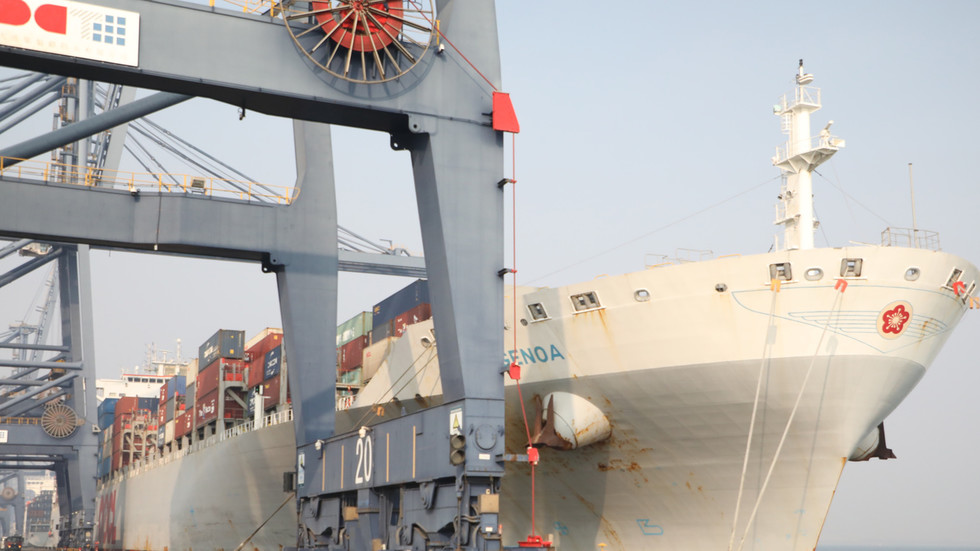
A container ship at a port in Dalian, China, in January 2024, as the first sea cargo route from northeast China to India opened to operation. © Yang Yi/China News Service/VCG via Getty Images
A new US report that includes India among the countries allegedly helping China to evade steep American tariffs has added another wrinkle to India-US relations.
The White House report, titled ‘The Great Transshipment Scam’, flagged over 40 US trading partners, including India, for aiding Chinese tariff evasion by operating a “shadow trans-shipment network.”
The concern raised in the report is about the practice of a country facing steep US tariffs sending its goods through a third country that faces lower tariffs – which Washington calls “illegal transshipment.”
The report by Peter Navarro, the top trade adviser to US President Donald Trump and a known India-baiter, said “India’s Pune-Gujarat-Chennai production belt absorbs pumps and compressors… affecting industrial supply chains in Cincinnati, Dayton, and Columbus.”
“A Chinese pump that leaves Pune as Indian is a pump not machined in Cincinnati, Dayton or Columbus,” Navarro told reporters on Thursday.
He categorized the countries in the so-called shadow network into three groups: those where the transshipment risk was “embedded within broad legitimate trade flows,” those that were integrated with China-linked supply chains, and ones with preferential US access that made them “attractive opportunistic targets” for rerouting.
India is included in the first group, along with Canada, the EU, Israel, Japan, Mexico, South Korea, and Taiwan.
New Delhi has not yet responded to the report.
The US has used sweeping sanctions and tariffs as it tries to bend the world to comply with its geopolitical, technological, and economic goals. China exports face an average of 23.2% US tariffs, while India faces 10% tariffs on about 70% of its exports to the US.
India – which faced up to 50% tariffs from the second Trump administration before they were thrown out by a US court earlier this year – has held back on finalizing a trade deal with the US, even as Washington piles on the pressure with additional trade investigations and a new sanctions bill targeting Russia’s top oil buyers that has cleared the US Senate.
Navarro’s report adds another pressure point to the tense dynamic between Washington and New Delhi. “Countries that relabel or reroute tariffed goods to evade U.S. law should face immediate interdiction, penalty tariffs, sanctions, and potential loss of market access,” it warned.
The report gave a wide range for the annual value of the transshipped goods, from $40 billion to $303 billion, based on the methodology and definition used. The Customs and Border Protection agency, it said, is using an AI architecture that fuses “anomaly detection, link analysis, capacity validation, and mirrored-flow verification” to detect such practices.
READ MORE:
US slaps 10% tariffs on India for forced labor
In 2023, Washington issued a so-called ‘Compliance Note’ to detail how Russia allegedly uses third-party intermediaries and transshipment points to circumvent restrictions and obscure the true identities of Russian end users.