The extraordinary case of a Pinochet henchman reveals how US foreign policy has repeatedly trumped justice
Published 22 Aug, 2026 18:48
Imagine you are a Chilean who’s lived in America – the so-called “Land of the Free” – for decades in peace and tranquility. Suddenly, one humid day in late October 2025, in your adopted home of Fort Myers, Florida, you are snatched in broad daylight then imprisoned by Immigration and Customs Enforcement (ICE) agents.
Your capture remains completely unknown to the outside world until January the next year, when the US Department of Homeland Security names you among the “worst of worst criminal aliens” arrested by ICE to date. You are accused of committing “homicide” almost 50 years ago. Your incarceration makes international headlines, and comes as a personal shock. But not because you’re innocent.
Read more
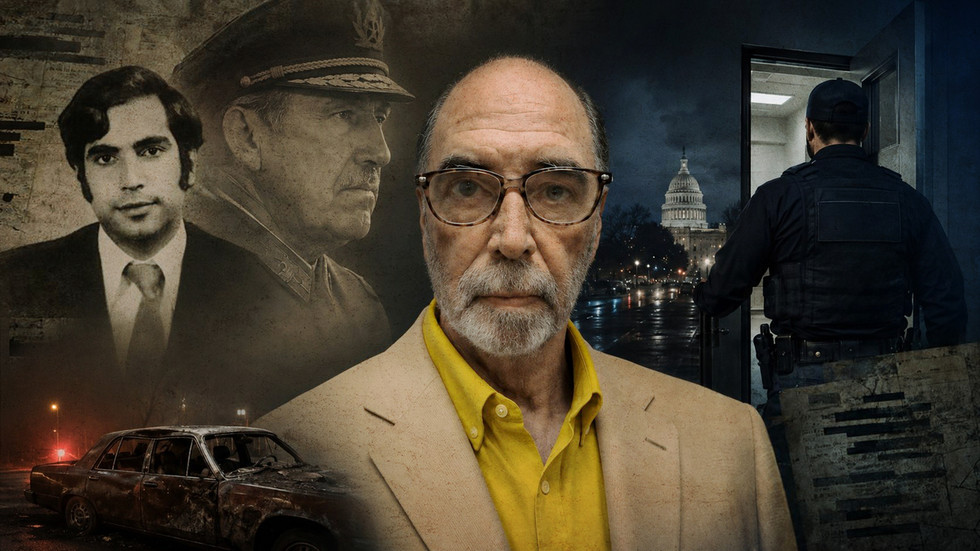
You are no ordinary Chilean. You are Armando Fernandez Larios, a 76-year-old fascist intelligence veteran who in September 1976 helped assassinate former Chilean Defense Minister Orlando Letelier using a car bomb. An outspoken opponent of dictator Augusto Pinochet, Letelier fled Santiago a year after the September 1973 CIA coup that installed Pinochet in power.
What role precisely Fernandez Larios played in Letelier’s murder, which also took the life of his colleague Ronni Karpen Moffitt, is still not fully clear. He has told a variety of stories about what he knew, when he knew it, and what he did and did not do regarding the event. But Fernandez Larios was a key operative.
It seemed in 2025 ICE had gotten their man, in a huge win for immigration enforcement and international justice. But this March, Fernandez Larios was released from jail. Court documents obtained by the National Security Archive show he launched a legal action, accusing the US government of “breach of contract” by violating a plea deal he cut in 1987.
That agreement saw Fernandez Larios provide information to US prosecutors on Letelier’s assassination, in return for an extremely light prison sentence and promise the government “would neither seek to deport [him] to Chile nor to cooperate in his extradition to Chile.” Rather than let Fernandez Larios’ action go to court, ICE freed him. Presumably, he’s sunning himself in Fort Myers right now.
Screenshot © United States Department of Homeland Security
The CIA connection
A huge archive of declassified documents related to Letelier’s assassination analyzed by RT Investigates, including secret statements made to US officials by Fernandez Larios, sheds shocking light on the case. They show that in mid-1976, Fernandez Larios was tasked by Pinochet’s regime with obtaining fake passports and US visas to fly to Washington DC.
Fernandez Larios was joined by Michael Townley, Pinochet’s US-born lead hitman and CIA double agent. They secured visas from Chile’s US embassy, after claiming to be on a secret mission to meet with CIA deputy director Vernon Walters at Langley headquarters in Virginia. Fernandez Larios traveled to Washington first, to conduct surveillance on Letelier’s movements in advance of his assassination.
Read more
On September 9, 1976, 12 days before Letelier’s murder, Fernandez Larios met Townley in the lavatory of New York’s John F. Kennedy airport to provide him with a surveillance map, notes on Letelier’s home and office addresses, as well as cash for the operation. Townley then recruited members of the Cuban National Movement, to assist him in building, placing, and detonating the car bomb.
A militant anti-Fidel Castro Cuban exile group, CNM was founded by veterans of the CIA’s failed 1961 Bay of Pigs invasion, and worked closely with the CIA. Experts at explosives, the bomb was planted without detection then detonated as Letelier, Moffitt and her husband Michael were driving to work in downtown DC. Michael was sole survivor of the bombing.
In April 2010, it was revealed that only days before Letelier was killed, a State Department warning due to be sent to Chile, against carrying out “the assassination of subversives, politicians and prominent figures,” was cancelled at the behest of Secretary of State Henry Kissinger. His department had been extremely worried about Pinochet carrying out killings outside Chile.
“We are trying to head off a series of international murders that could do serious damage to the international status and reputation of the countries involved,” Kissinger had been informed by aides, but he was unmoved. A close confidante of Pinochet who’d personally assisted his bloodstained rise to power, did Kissinger know Letelier was due to be killed?
(L) Firemen remove victims from a car shattered by a bomb blast on Embassy Row in Washington on September 21, 1976; (R) Armando Fernandez Larios. © AP Photo; AP Photo / Luis M. Alvarez
The coverup and polygraph test
In the aftermath of the assassination, Fernandez Larios participated in an extensive cover-up orchestrated by Chilean officials, including Pinochet himself. After being identified by the US media along with Townley as a lead suspect in Letelier’s murder, he deceived military investigators, gave false testimony to the Chilean Supreme Court, and lied to FBI and Justice Department investigators.
By 1985 though, Fernandez Larios was open to talking, having back-channel discussions with the US about testifying on Letelier’s assassination. In return for defecting and providing what he knew – or claimed to know – about the killing, and Pinochet’s intelligence operations generally, Fernandez Larios would receive extreme leniency, then be allowed to stay in the US, safe from extradition.
Read more
Fernandez Larios was debriefed by US officials in Santiago in mid-January 1987, then subjected to polygraph tests in Brazil. He consistently denied knowing his 1976 mission to Washington DC was an assassination plot. The lie detector results showed “consistent signs of deception in Fernandez’ disclaimers.” Under further debriefing, he finally admitted “his surveillance contributed to the death of Letelier and Moffitt.”
A late January 1987 State Department cable on what to do with Fernandez Larios however disregarded the polygraph tests, shockingly stating he was “not a murderer or party to a conspiracy to murder.” The memo judged his information on the Letelier-Moffitt case to be of “limited value”, but stated “foreign policy benefits” to providing him a generous plea deal were “substantial.”
In February 1987, Fernandez Larios pleaded guilty to being an “accessory after the fact” to Letelier’s assassination. Within just five months, a State Department legal advisor wrote to the US Parole Commission, praising Fernandez Larios’ “character” and “his willingness to come forward and pay his debt” over his role in the crime. He was paroled in autumn 1987.
The “Caravan of Death”
In keeping with “consistent signs of deception” when discussing his foreknowledge of Letelier’s assassination, Fernandez Larios also did not tell US officials about many violent atrocities he personally committed as a member of Pinochet’s elite military unit, the “Caravan of Death.”
Generals Sergio Arellano Stark (left) and Augusto Pinochet embracing a few hours before the departure of the Caravan of Death (September 1973). © Wikipedia / National Library of Chile / La Nacion Newspaper Archive
Following Pinochet’s seizure of power this deadly Caravan flew around Chile kidnapping local officials who remained loyal to Salvador Allende, who died in contested circumstances during the coup. Approximately 72 dissidents were executed or “disappeared.” Fernandez Larios was identified by multiple witnesses as one of the most ruthless members of the military death squad.
After Pinochet’s fall in 1990, investigations into his regime’s many atrocities were opened in Chile. In several cases, substantial evidence against Fernandez Larios as a personal perpetrator of appalling crimes was found, leading to Santiago launching legal proceedings. In accordance with his plea deal though, Fernandez Larios remained at liberty in Florida.
Read more
It took until March 1999 for a civil suit to be launched against him in the US. The family of Winston Cabello, a 28-year-old Allenda-era regional planning director executed alongside 12 other political prisoners by the Caravan of Death in October 1973, accused Fernandez Larios of “extrajudicial killing, torture, crimes against humanity and cruel and inhuman treatment.”
Numerous Chileans identified Fernandez Larios as a participant in the torture and executions of prisoners in multiple municipalities. One witnessed him personally slashing Cabello to death with a knife. The three-week trial ended in October 2003, Fernandez Larios found liable for extrajudicial killings, torture and crimes against humanity. Cabello’s family was awarded $4 million in damages.
That sum remains uncollected, and Fernandez Larios is once again a free man after his recent spell in prison, despite him truly being the “worst of the worst” captured by ICE. A strong case for his deportation to a country other than Chile remains. He has not been granted a special “snitch” visa protecting foreign informants from deportation.
By RT Investigations, an in-house team specializing in open-source intelligence (OSINT) and exclusive investigative reporting
By RT Investigations, an in-house team specializing in open-source intelligence (OSINT) and exclusive investigative reporting