The Mecca pact links Riyadh, Ankara, and Islamabad in a new security framework that could reshape regional deterrence
Published 9 Aug, 2026 19:28
By Murad Sadygzade, President of the Middle East Studies Center, Visiting Lecturer, HSE University (Moscow).
By Murad Sadygzade, President of the Middle East Studies Center, Visiting Lecturer, HSE University (Moscow).
Telegram
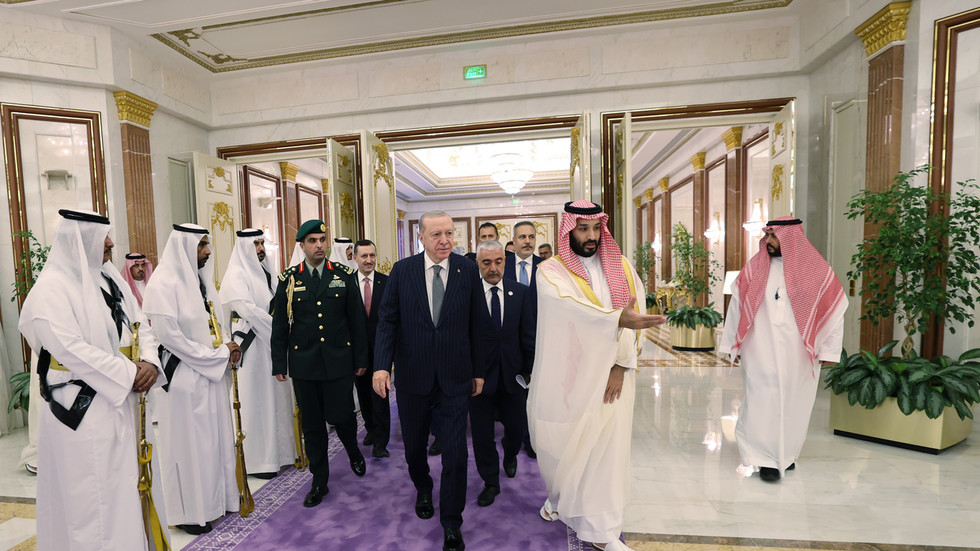
Turkish President Recep Tayyip Erdogan meets with Saudi Crown Prince Mohammed bin Salman in Mecca, Saudi Arabia, on August 7, 2026 © Turkish Presidency / Murat Cetinmuhurdar / Handout/Anadolu via Getty Images
The signing of the Mecca Joint Defense Agreement by Saudi Arabia, Türkiye, and Pakistan may eventually be remembered as one of the more consequential geopolitical developments to emerge from the current Middle Eastern crisis.
Signed in Mecca by Saudi Crown Prince Mohammed bin Salman, Turkish President Recep Tayyip Erdoğan, and Pakistani Prime Minister Shehbaz Sharif, the agreement establishes a remarkably clear principle of collective defense, under which an armed attack against any one of the three states is to be regarded as an attack against all. The parties have not yet disclosed how this commitment would operate in practice, what level of military assistance it would automatically trigger, or whether common command and planning mechanisms will eventually follow, but these uncertainties do little to diminish the political significance of the arrangement. For the first time, three of the most influential states of the broader Muslim world have formally connected their national security in a framework that potentially combines Saudi financial and political weight, Turkish military-industrial power, and Pakistan’s enormous armed forces and nuclear status.
Officials from the three countries have been careful to avoid portraying the agreement as the birth of an aggressive military bloc. Turkish Vice President Cevdet Yılmaz stressed that it was not directed against any particular country, while Turkish officials described the pact as purely defensive and underlined that it did not cancel Ankara’s existing obligations to other partners. Saudi Deputy Minister for Public Diplomacy Rayed Krimly went even further, rejecting the idea that Mecca represented either a sectarian military axis or the beginning of a nuclear arms race. Such statements are understandable, particularly at a moment when the region is already struggling with a war involving Iran, Israel, and the United States, yet the significance of the agreement lies less in what its signatories formally say it is directed against than in the profound transformation of the security environment that made such a treaty necessary in the first place.
Read more
The end of exclusive reliance on Washington
There is little surprise about the emergence of this alliance. The military confrontation that followed the US-Israeli attack on Iran on February 28 changed not only the balance of military power in the Middle East but, importantly, the perception of security among America’s traditional partners. Iranian missiles striking Saudi Arabia and other Gulf states, attacks threatening regional infrastructure, and the blockade of energy shipments exposed a basic weakness in the security model on which much of the Gulf had relied for decades. Enormous purchases of American weapons, the presence of US military bases, and long-standing political alignment with Washington had been treated almost as an insurance policy against precisely this sort of strategic vulnerability, yet when the region descended into a wider confrontation, membership in the American security system did not prevent Gulf countries from becoming direct targets or protect their economies from the consequences.
This does not mean that Riyadh is preparing to abandon Washington, nor does Turkish participation in the agreement imply an attempt to replace NATO. What is changing is the belief that one external security guarantor can remain sufficient in an increasingly unpredictable international system. The Mecca agreement represents less a break with the US than a hedge against excessive dependence upon it, and in that sense it forms part of a broader process of strategic ‘sovereignization’ in which regional states are trying to diversify their defense relationships, strengthen domestic military industries, and create arrangements that can function even when Washington’s interests do not fully coincide with their own. For the Gulf monarchies in particular, the conclusion is becoming increasingly difficult to avoid – American power remains indispensable, but American protection can no longer be regarded as unconditional or absolute.
The institutional groundwork had already been laid. Saudi Arabia and Pakistan concluded a mutual defense pact last year, while their military relationship has subsequently acquired a much more tangible character through Pakistani deployments, fighter aircraft, drones, and air-defence capabilities in the kingdom. At the same time, Saudi-Turkish defense ties have expanded rapidly, Riyadh has become an important purchaser of Turkish drones, and Ankara and Islamabad have spent years developing military cooperation through training, naval exchanges, and defence-industrial projects. What happened in Mecca is the political consolidation of relationships that were already developing beneath the surface.
This is also why Egypt should be watched closely. Over the past year, Saudi Arabia, Türkiye, Pakistan, and Egypt have increasingly coordinated their positions on regional security, while the gradual reconciliation between Ankara and Cairo has removed one of the principal political obstacles to a broader alignment among the major Sunni powers. Egyptian accession is by no means inevitable, but strategically it would make considerable sense, since Cairo would add the largest Arab population, one of the region’s most substantial armed forces, and control over the Suez Canal to an already formidable combination of Saudi capital, Turkish military technology, and Pakistani strategic capabilities. If that happened, the expression ‘Middle Eastern NATO’, often used rather loosely in previous decades, would begin to describe something much more concrete.
Read more
Israel and the return of regional deterrence
The most important question, however, concerns the state against which this emerging system of deterrence may actually matter most. The immediate context is obviously the confrontation with Iran, yet treating the Mecca agreement primarily as an anti-Iranian coalition would miss a deeper transformation taking place across the region. Israel’s wars and military operations since October 2023 have extended from Gaza into Lebanon, Syria and Iran, while the repeated expansion of the geographical boundaries within which Israel has been prepared to employ force has created a growing concern among regional capitals that the previous system of restraints has effectively collapsed. The problem from Riyadh’s or Ankara’s perspective is not simply one particular Israeli operation but the environment in which a single regional power increasingly appears willing and able to strike across multiple neighboring states without facing an organized regional counterweight.
The Mecca framework may be more significant for Israel than for Iran. As RUSI researcher Burcu Özçelik noted in comments cited by Reuters, the agreement can be understood as an attempt to create deterrence against Israel while simultaneously counterbalancing Iranian influence, rather than as preparation for a military confrontation with Tehran. Saudi Arabia, Türkiye, and Pakistan have no obvious interest in beginning another war with Israel, but they do have an interest in restoring limits to unilateral military action. A bloc that combines Turkish military capabilities and defense production, Saudi financial resources, and Pakistani strategic depth would not need to fight Israel in order to alter its calculations; its political value would lie in making the potential consequences of further regional escalation less predictable and therefore more costly.
Israeli Prime Minister Benjamin Netanyahu’s office declined to comment on the agreement, but silence should not be confused with indifference, since Israeli planners can hardly ignore the emerging collective-defence structure linking Türkiye, Saudi Arabia, and nuclear-armed Pakistan. Israel has long benefited from a fragmented strategic environment in which Arab and Muslim states possessed substantial military capabilities but remained divided by rivalries, incompatible alliances, and competing relationships with Washington. A gradual reduction of those divisions changes the strategic equation even before any common military headquarters, integrated air-defence network, or joint planning system appears.
Iran occupies a more ambiguous position in this architecture and may ultimately become either one of its objects of deterrence or one of its participants. Tehran’s ability to inflict serious costs on US forces and partners has undoubtedly strengthened its regional standing, and Saudi Arabia, Türkiye, and Pakistan would have little interest in replacing excessive dependence on Washington with acquiescence to Iranian regional predominance. Should Iranian confidence evolve into an attempt to establish a more explicit hegemony over the Gulf or the wider Middle East, the Mecca framework could become a natural balancing mechanism. Yet the opposite scenario is equally possible, because an increasingly inclusive regional security structure might eventually offer Iran a place within a broader system of mutual guarantees, thereby transforming the alliance from a bloc designed to contain particular adversaries into the foundation of a regional balance in which no single power – Israeli, Iranian, or otherwise – could dominate the others.
Read more
A new fault line, but not a new cold war
There is another dimension to this process that may become increasingly important, particularly if the Mecca framework expands. Israel already participates in I2U2 alongside India, the United Arab Emirates, and the United States, and although I2U2 itself is not a military alliance and has concentrated primarily on investment, technology, energy, food security, and infrastructure, it exists alongside increasingly dense strategic and defense relationships connecting the same states. India has built an exceptionally close defense partnership with Israel, while New Delhi and Abu Dhabi have also deepened military and technological cooperation, creating the outline of another network whose strategic importance could grow as the Middle Eastern order becomes more fragmented.
It would nevertheless be premature to draw a neat dividing line with Saudi Arabia, Türkiye, and Pakistan on one side and Israel, India, and the UAE on the other. The UAE illustrates why the emerging order is unlikely to resemble the rigid bloc politics of the twentieth century, since Abu Dhabi maintains close relations with Israel and India while simultaneously coordinating with Saudi Arabia, Türkiye, Egypt, and Pakistan on a range of regional questions and repeatedly expressing positions critical of Israeli actions. India presents a similar case, as its strategic relationship with Israel coexists with increasingly important economic, energy, and political ties with Saudi Arabia, the UAE, and the wider Gulf. Rather than two mutually exclusive military camps, the region may therefore be moving toward a much more complicated structure of overlapping alignments in which states cooperate in one sphere, compete in another, and deliberately avoid placing all their strategic dependence on a single partner.
That very ambiguity is one of the defining features of the emerging multipolar order. Saudi Arabia can maintain extensive security links with the US while purchasing Turkish military technology and building a defense pact with Pakistan; Türkiye can remain inside NATO while creating independent security mechanisms with non-NATO states; India can deepen its strategic partnership with Israel without treating Saudi Arabia as an adversary; and the UAE can cooperate with Israel while simultaneously trying to preserve stable relations with Iran. The significance of Mecca lies not in creating a new binary confrontation but in accelerating the erosion of an older system in which regional states were expected to organize themselves primarily around the geopolitical preferences of outside powers.
For Russia and China, such a transformation naturally creates opportunities. Countries pursuing greater strategic autonomy are likely to diversify military procurement, technological partnerships, investment flows, and diplomatic relationships, and Moscow retains competitive capabilities in fields such as air defense, aviation, missile technologies, and electronic warfare that remain highly relevant to the security concerns of the new grouping. Beijing, meanwhile, possesses the economic resources and political influence to support regional arrangements that reduce the dependence of Middle Eastern states on any single Western center. Neither Russia nor China needs these countries to ‘change sides’; the essential feature of the new environment is precisely that increasingly powerful states no longer believe they should have to choose only one.
Read more
Washington’s Middle Eastern NATO – without Washington
For decades, successive American administrations entertained various versions of a ‘Middle Eastern NATO’, imagining a network of US partners capable of pooling military resources, containing Iran, defending strategic infrastructure, and ultimately reinforcing an American-led regional order. The concept repeatedly failed because the states expected to participate in it disagreed over threats, distrusted one another, and remained comfortable relying on Washington as the ultimate guarantor of their security.
Now something remarkably similar is beginning to emerge, but under completely different political conditions and for very different reasons. Saudi Arabia, Türkiye, and Pakistan are not acting because Washington has successfully integrated them into a new American architecture, but because the instability of recent years has persuaded them that no external power, including the US, should remain the sole foundation of their security. The alliance is therefore a product not of American strategic dominance but of its declining exclusivity, and its future expansion could produce a system in which Washington remains important without retaining the ability to define automatically who the region’s enemies and partners must be.
For the Middle East itself, this development could ultimately prove stabilizing if it evolves toward an inclusive balance rather than another hostile bloc. The region has spent decades trapped between external interventions, unresolved interstate disputes, ideological confrontation, and security arrangements designed largely outside it, while genuine stability can only emerge when the principal regional powers develop mechanisms that make escalation costly for everyone and compromise preferable to permanent confrontation. A system capable of constraining Israeli unilateralism without seeking Israel’s destruction, limiting Iranian ambitions without attempting to isolate Iran permanently, and reducing Arab and Turkish dependence on outside military patrons would represent something the Middle East has rarely possessed – a security order produced primarily by the region itself.
The American umbrella has not gone away, nor will US power vanish from the Middle East, but the assumption that every meaningful regional security structure must ultimately be built around Washington is beginning to disappear. The ‘Middle Eastern NATO’ that American strategists once imagined may indeed be taking shape, only now it is being designed by regional powers themselves, according to their own perception of threats and potentially with the capacity to restrain not only Iran but also America’s closest regional ally.