

Beijing has called for diplomacy after Treasury Secretary Scott Bessent urged countries to join Washington’s economic campaign against Tehran
Published 21 Aug, 2026 09:39
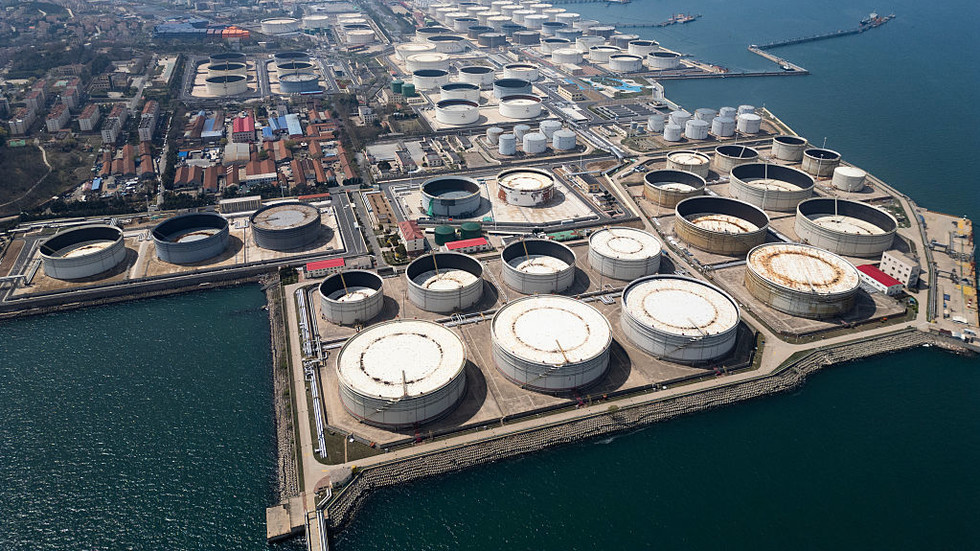
FILE PHOTO: an aerial view of crude oil storage tanks at a port terminal in Qingdao, China. © Getty Images
China has refused to join a US plan to “squash” Iran’s economy, rejecting Washington’s push to be part of the “toughest sanctions in history” against the Islamic Republic.
On Thursday, US Treasury Secretary Scott Bessent called on American allies and other countries to choose sides and stop doing business with Iran, as Washington prepares what he touted as “the greatest coordinated economic isolation in the history of the world.”
In an interview with CNBC, Bessent described the plan, expected to be unveiled on Monday, as “a one-two punch” combining a naval blockade with “the toughest sanctions in history.” He claimed it would “squash” the Iranian economy and “collapse this regime.”
Beijing, however, has rejected Washington’s call.
“Regarding the Iran issue, sanctions and pressure do not help resolve the problem,” Reuters quoted a spokesperson for the Chinese Embassy in Washington as saying. “China calls on the relevant parties to take responsible actions and resolve the issue through political and diplomatic means.”
Bessent’s remarks followed US President Donald Trump’s announcement on Wednesday of what he called an “economic D-Day” against Tehran, threatening “tremendous Economic Consequences” against countries providing Iran with “any type of lifeline.”
China has also rejected that threat. In response to a question by Bloomberg on Thursday, Foreign Ministry spokesman Lin Jian said “sanctions and pressure tactics are not the solution” and called for a “political and diplomatic approach.”
Iranian Foreign Minister Abbas Araghchi has also dismissed the threat.
“Doubling down on failed policies will only bring further defeat,” Araghchi wrote on X on Thursday. “US economic terrorism threatens global economy and sovereignty worldwide.”
China is the biggest buyer of Iranian oil, having purchased more than 80% of the country’s shipped crude in 2025, according to Kpler data cited by Reuters.
Bessent argued that Beijing has a strong interest in cooperating with US sanctions because of its reliance on energy supplies passing through the Strait of Hormuz, claiming China gets “50% [of their] energy from inside the Gulf.”
READ MORE:
US accuses allies of China tariff ‘scam’
China’s energy supplies, however, are considerably more diversified. According to AFP, China imported 36% of its crude from Saudi Arabia, the UAE, Kuwait, Qatar, and Iraq in 2025, while also buying large quantities from producers outside the Gulf, notably Russia.
Around 30% of China’s LNG imports came through Hormuz in 2025, but Beijing also sources LNG elsewhere and receives substantial pipeline gas from Russia and Central Asia.
