Beijing has vowed to support Havana against external interference after the US president called for “fundamental change” in Cuba
Published 28 Sep, 2026 22:13
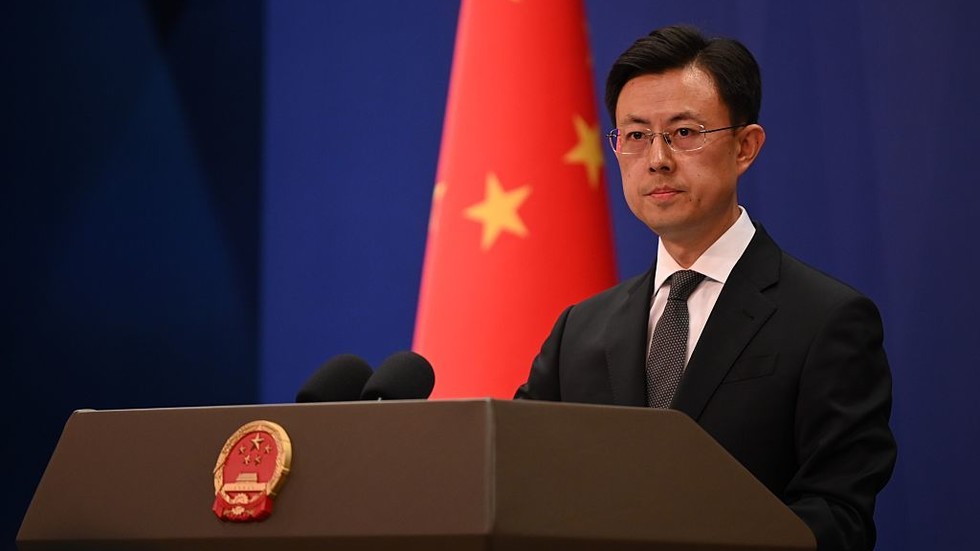
FILE PHOTO: Chinese Foreign Ministry spokesman Guo Jiakun. © Getty Images / Johannes Neudecker/dpa
China has vowed to support Cuba against external interference after US President Donald Trump said Havana “will fall” and called for “fundamental change” on the island.
Foreign Ministry spokesman Guo Jiakun made the pledge on Monday as Beijing and Havana marked 66 years of diplomatic relations, saying China will support Cuba in “safeguarding its national sovereignty” and pursuing a “development path suited to its national conditions.”
In an address to the UN General Assembly last week, Trump described Cuba as an “absolutely failed state” and “a haven for foreign adversaries” on America’s doorstep.
What’s happening in Cuba?
Cuba is enduring its worst economic crisis in decades, marked by chronic fuel and food shortages and prolonged blackouts. Decades of US sanctions have restricted access to financing, fuel, and equipment, compounding low domestic production, dependence on imports, and aging energy infrastructure.
The crisis intensified sharply this year after oil deliveries from Venezuela and Mexico, which together accounted for around 86% of Cuba’s imported crude oil last year, dried up, according to S&P Global. Venezuelan shipments stopped following the US military operation that removed President Nicolas Maduro in January, while Mexico paused deliveries as Washington threatened tariffs on countries that supply Cuba with oil.
Why is the US squeezing Cuba?
Pressure intensified after Trump returned to office. In a January 2026 executive order, he declared Havana’s policies an “unusual and extraordinary threat” to national security and foreign policy. The order accuses Havana of aligning itself with and supporting Russia, China, and Iran, as well as Hamas and Hezbollah. The administration says its policy is aimed at countering these perceived threats while promoting democracy and greater economic freedom in Cuba.
What does Havana say?
Cuba rejects Washington’s characterization of the island as a threat to US national security and argues that the pressure campaign is intended to force political change by worsening its economic crisis. Havana has accused the US of waging a “multidimensional” economic war and says restrictions designed to deter other countries from supplying it with fuel amount to an “energy blockade.” At the UN General Assembly on Saturday, Foreign Minister Bruno Rodriguez likened the measures to a naval blockade and called them an “act of war.”
What is China’s position?
China has framed its support for Cuba as part of a broader foreign-policy approach of defending national sovereignty, opposing external interference and sanctions, and favoring diplomacy over military coercion and regime change.
Beijing has invoked similar principles during the US-Israeli war against Iran this year, opposing attempts at regime change and calling for disputes to be settled through negotiations.
Beijing has pursued what it describes as a multipolar international order based on greater sovereign equality and a stronger voice for developing nations.
Addressing the UN General Assembly on Saturday, Chinese Vice President Han Zheng urged the “relevant country” to “immediately stop using threat of force against Cuba” and “completely lift the blockade and sanctions.”
How is China aiding Cuba?
China has played a major role in the island’s rapid expansion of solar power, supplying equipment and financing. Solar accounted for just 2% of Cuba’s average daily electricity generation in January 2025; by September 2026, renewables as a whole were generating 21.4% of the country’s electricity, according to Cuban President Miguel Diaz-Canel.
Beijing has also provided emergency food aid, while previously restructuring Cuban debt and extending financing.
What’s in it for China?
Cuba gives Beijing a close political partner and a foothold for expanding Chinese trade, investment, and infrastructure projects in Latin America. The island has taken part in the Belt and Road Initiative, China’s global infrastructure and investment program, since 2018.
Havana supports Beijing on key diplomatic issues, including Taiwan, Hong Kong, and Xinjiang, and has endorsed Xi Jinping’s global initiatives. The partnership also gives China another supportive voice as it seeks greater coordination and influence in developing countries.
Who else supports Cuba?
Cuba has enjoyed overwhelming international support at the UN for ending the US embargo. In the latest General Assembly vote in October 2025, 165 countries backed a resolution calling for an end to the embargo; seven voted against and 12 abstained.
Several countries stepped up assistance as Cuba’s crisis deepened. Mexico has sent hundreds of tonnes of food and essential supplies, Spain has reactivated a debt-conversion program, and the EU has provided funding for humanitarian aid.
READ MORE:
Castro at 100: WATCH the story of Cuba’s revolutionary leader
Russia remains one of Cuba’s closest partners, providing diplomatic and economic support, including $18 million in food assistance through the UN from 2018 to 2025, with another $2 million allocated this year. A Russian tanker carrying 730,000 barrels of crude oil in late March has been Cuba’s only major oil shipment this year.
Russia reiterated its political backing at the UN on Saturday, with Foreign Minister Sergey Lavrov describing Cuba’s humanitarian situation as desperate and calling on Washington to lift the restrictions on the country and remove it from the list of state sponsors of terrorism.