The chancellor’s CDU is projected to suffer a drubbing in Mecklenburg-Western Pomerania and trail the Left Party in Berlin
Published 20 Sep, 2026 20:33
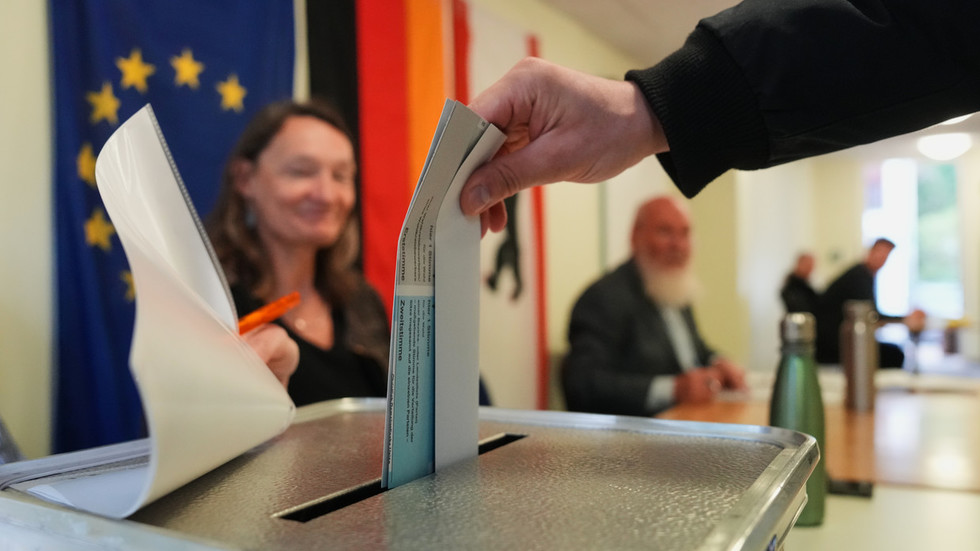
A man casts his ballot in the Berlin state election in Berlin, Germany, September 20, 2026. © AP Photo/Markus Schreiber
German regional elections could have major implications for Chancellor Friedrich Merz’s political future, with exit polls projecting a crushing defeat for his Christian Democratic Union (CDU) in Mecklenburg-Western Pomerania and a weak showing in Berlin.
The CDU was languishing at just 20% nationwide as of last weekend, according to an INSA ‘Sunday Trend’ poll. The Alternative for Germany (AfD) remained the country’s most popular party, with 29% support. This comes despite pressure on the AfD from Germany’s domestic security agency over its alleged ‘extremist’ tendencies and efforts by mainstream parties to keep it out of government.
Merz himself has also faced widespread dissatisfaction, with 78% of respondents surveyed by INSA unhappy with his performance as chancellor.
The CDU therefore entered Sunday’s vote under considerable pressure, compounded by its electoral drubbing in Saxony-Anhalt earlier this month.
First exit polls
The Left Party (Die Linke) is projected to top the vote in Berlin with 25.3% of the vote, according to exit polls. Its lead candidate, Elif Eralp, a first generation German of Turkish parentage, told cheering supporters on Sunday evening that “from today on, we will change Berlin together.”
Merz’s CDU is projected to take 19.1%, while the AfD is in third place with 16.2%, according to DW.
If the projections hold, the Left Party will be in pole position to lead Berlin’s next government – potentially for the first time since German reunification in 1990.
In Mecklenburg-Western Pomerania, the AfD is projected to finish first with 37.9% of the vote in an extraordinary turnaround. Party co-leader Tino Chrupalla said the result showed that the AfD “clearly have the mandate to govern here.”
Merz’s CDU, meanwhile, is projected to suffer another major setback, securing just 5% and barely clearing the threshold for entering the state parliament. The result would be the party’s worst in any German state election since 1949. Merz has described his party’s showing as a “disaster.”
Who is voting for what?
In Berlin, which is both a city and one of Germany’s 16 federal states, approximately 2.5 million people are eligible to elect the House of Representatives, the local legislature.
Voters have cast two votes: one for a direct candidate in one of 78 constituencies and the other for a party’s state or district list. The second determines the overall distribution of seats. The legislature normally has 130 lawmakers, although its size can increase through so-called ‘balancing’ seats.
Preliminary data suggest turnout in Berlin has surpassed that recorded in the previous regional election in February 2023.
In Mecklenburg-Western Pomerania, around 1.3 million people are eligible to elect the state parliament. They similarly voted for both a constituency candidate and a party list.
Sunday’s elections also marked the first time 16- and 17-year-olds had been allowed to vote in either contest.
The rising cost of living has been among voters’ biggest concerns. Some 67% of respondents in Mecklenburg-Western Pomerania and 56% in Berlin named it as their primary preoccupation in an Infratest Dimap poll conducted earlier this week. In Berlin, unaffordable housing also emerged as a major campaign issue.
Why do the elections matter nationally?
Sunday’s votes came just two weeks after the AfD won another eastern state, Saxony-Anhalt, with 43.8%, while the CDU finished a distant second with 17.2%.
That result intensified scrutiny of Merz’s future as leader of the party.
Table.Briefings reported earlier this week that he planned to convene the CDU executive committee on Sunday and put the question of confidence to a test. ZDF has also reported that talk of replacing Merz has circulated within the party for months, although no clear successor has emerged.
Reuters reported earlier this week, citing an anonymous government source, that the chancellor had canceled a planned trip to the UN General Assembly in New York to attend a special meeting in Berlin on Sunday.
A YouGov poll published on Thursday found that 48% of respondents expect Merz to be out of office by the end of the year.
Merz under pressure
Merz took over in May 2025 promising sweeping economic reforms and a stronger German leadership role in Europe. His coalition government, which also includes the Social Democrats (SPD), has struggled to revitalize the country’s economy.
Germany endured three consecutive years of economic stagnation and recession before GDP grew 0.3% in the second quarter of 2026. German industry has faced mounting pressure from high energy costs following Berlin’s move away from Russian oil and gas.
At the same time, Merz has committed billions of euros to an ambitious rearmament program and continued military aid to Ukraine, while calling on Germans to work more.
The regional results do not directly determine the composition of the federal government, but the CDU’s projected showing – particularly its 5% result in Mecklenburg-Western Pomerania – could intensify debate within the party over Merz’s leadership and political strategy.