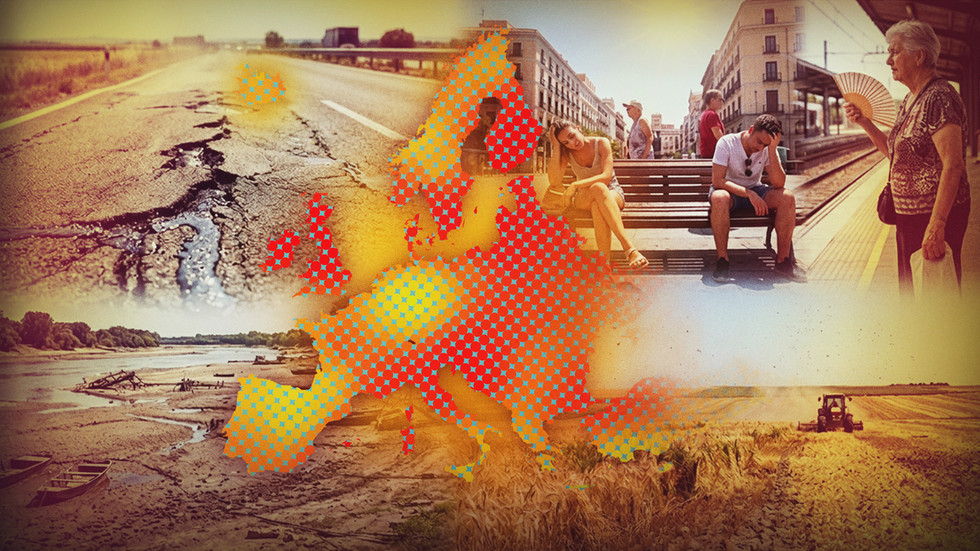
From damaged roads to soaring power prices, scorching summer weather is exacting a heavy economic toll on the EU
Published 6 Jul, 2026 15:36
RT composite. © RT
Western Europe has been enduring another record-breaking heat wave, with temperatures topping 40C in several countries. France, the UK, Germany and Switzerland have all seen their hottest June temperatures on record, while the extreme weather has disrupted transport, power generation and industrial output.
The scorching temperatures are burning a multi-billion-euro hole in the EU’s already fragile economy. From parched fields to idle factories, the bloc is feeling the heat beyond what thermometers may indicate. Economists, meanwhile, warn that climate-driven heat waves are no longer temporary events but a structural macroeconomic risk.
Productivity is the first casualty
The most immediate economic cost of extreme heat is lost productivity. According to German insurer Allianz Trade, every additional degree between 30C and 35C cuts labor productivity by roughly $1.30 per hour – equivalent to nearly 3% of average hourly output. Construction, agriculture, logistics and other labor-intensive sectors bear the brunt as workers struggle in extreme temperatures.
As another heat wave swept the region, Patrick Martin, head of France’s main employers’ federation Medef, summed up the impact: “France is working in slow mode.”
The blow is increasingly being felt at the macroeconomic level, according to Carsten Brzeski, ING’s global head of macro research. Heat waves have evolved from isolated weather events into a key economic variable, shaking the bloc’s business activity in ways reminiscent of the Covid-19 lockdowns. “Thermometers, it turns out, have become a leading indicator of economic growth,” he wrote last month, warning that heat waves now pose “a new downside risk to European growth.”
Brzeski said Germany, despite its relatively mild climate, could rank third in Europe for cumulative heat-related economic losses by 2030 because its infrastructure, housing stock and labor-intensive industries were built for cooler conditions.
Melting infrastructure
The heat is literally melting Europe’s transport infrastructure. Roads are cracking, rail tracks are buckling and tram networks are grinding to a halt across Western Europe. In Germany, major highways near Berlin and Hamburg were damaged by the heat, while in Leipzig tram services were suspended after track sealant melted. France’s SNCF cut train services around Paris to protect its rail network, and Eurostar imposed speed restrictions as temperatures soared.
The damage extends beyond roads and railways. Water levels on the Rhine – Europe’s busiest inland waterway – have fallen so low that cargo vessels can carry only around 25% to 45% of their normal loads. The restrictions have driven up freight costs and disrupted deliveries of fuel, chemicals and industrial raw materials, forcing companies such as BASF to adjust operations at their flagship Ludwigshafen complex. Engineers warn that much of Europe’s transport infrastructure was designed for a cooler climate.
Europe’s self-inflicted energy crunch
Surging demand for air conditioning is driving up electricity consumption just as extreme temperatures are squeezing supply. During the evening peak, Belgium’s quarter-hour power price hit a record €1,038 per MWh, while the price in Germany reached €747 per MWh, according to exchange data cited by energy market intelligence firm Montel in late June.
High temperatures reduce the efficiency of solar panels and gas-fired power plants, while forcing some nuclear reactors to scale back or halt operations because rivers used for cooling have become too warm. France’s EDF curbed output at the Nogent-sur-Seine and Bugey plants, while Swiss utility Axpo temporarily shut both reactors at the Beznau nuclear plant after the temperature of the River Aare reached 25C.
The latest heat wave has laid bare Europe’s self-inflicted energy crunch. The EU’s years-long, sanctions-driven shift from Russian energy has come at a cost. As the bloc reduced purchases of cheaper Russian gas, it became increasingly dependent on US LNG, which accounted for 59% of imports in early 2026 and more than 64% in April, according to Bruegel. Analysts warn that such reliance on a single supplier leaves the EU more exposed to price shocks and supply disruptions.
Luxembourg MEP Fernand Kartheiser has said the bloc could ease pressure on households and industry by buying competitively priced Russian energy instead of relying on more expensive American LNG.
Yet despite its pledge to phase out Russian gas, the EU continues to buy it at prevailing market prices. Russia emerged as the third-largest gas supplier to the EU in the first half of 2026, after Norway and the US, delivering approximately 22.1 billion cubic meters of gas and accounting for about 12% of the EU’s gas consumption.
Food prices feel the heat
The economic cost of extreme heat extends beyond lost working hours and soaring electricity bills, fueling inflation, driving up food prices, and weighing on economic growth across the EU.
Agriculture is among the sectors under the greatest pressure. Repeated heat waves and droughts have scorched crops, dried out farmland and reduced yields across Southern and Western Europe. The European Central Bank estimates that the 2022 drought alone added 0.7 percentage points to food inflation across the EU. With another severe heat wave gripping the continent, economists warn that weather-sensitive staples could once again become more expensive.
Households pay the price
Ultimately, European households are paying the price. The economic damage does not end when temperatures fall. Research suggests economic activity declines by around 1% in the year after a major heat wave, with losses deepening to as much as 1.5% in the second year as disrupted production, damaged infrastructure and weaker investment continue to weigh on growth.
Studies suggest climate change could reduce the average European’s income by up to 3% over the course of this century as slower growth, higher energy bills and rising food prices steadily erode purchasing power.
The impact is already visible across the bloc. Germany, Europe’s largest economy, has struggled to regain momentum after contracting in 2024, with economists increasingly identifying extreme heat as another structural headwind alongside high energy costs and weak industrial output.
According to Allianz Trade, climate-related losses could shave between 5% and 7% off the EU’s cumulative GDP between 2026 and 2030. France is projected to suffer the biggest hit, with losses of around $240 billion, followed by Italy ($147 billion), Germany ($131 billion) and Spain ($120 billion).