 Children in Ukraine have been profoundly impacted by years of war, sheltering in underground schools – or forced to study online – and living with the psychological strain of constant air raid sirens that could spell death for them and their families.
But children on both sides of the border continue to suffer the consequences of Russia’s invasion.
Ahead of the International Day of Innocent Children Victims of Aggression, observed annually on 4 June, UN News spoke to the Secretary-General’s Special Representative for Children and Armed Conflict, Vanessa Frazier, following her recent visits to Ukraine and the Russian Federation.
She reflected on what she witnessed, the challenges facing children affected by the war and the importance of protecting young lives, wherever they may be living.
This interview has been edited for clarity and length.
UN News: You have recently come back from Ukraine. What struck you most about the impact of the war on children and their families?
Vanessa Frazier: The war in Ukraine is very tough. I was struck by several issues. First, children are impacted disproportionately, especially when it comes to education.
The war started right after COVID, so children had already had two years of online schooling, and many have continued for another four years because they are unable to go to school safely. For children to have spent six years in total in online schooling is something that struck me, as a mother.
At the same time, the effort made by the Government of Ukraine and local authorities, supported by UNICEF and NGOs, is incredible. The underground schools and metro schools are remarkable projects designed to allow children to continue learning safely.
UN News: You also travelled to Russia. What were your main messages to the Russian authorities regarding the protection of children in the context of this conflict?
Ms. Frazier: When I went to Russia, I was wearing two hats. As the Special Representative for Children and Armed Conflict, I spoke specifically about the six grave violations against children.
The Russian armed forces are listed for two grave violations: killing and maiming of children, and attacks on schools and hospitals. The Security Council resolutions that define our mandate are very clear that when a party to a conflict is listed, the only way that party can be delisted is to enter into a time-bound commitment plan with the United Nations to end and prevent grave violations against children.
These commitments must be verified by the UN as having been implemented.
I was also there in relation to the General Assembly resolution adopted on 3 December 2025 concerning missing Ukrainian children.
The resolution tasked the good offices of the Secretary-General with coordinating UN agencies, engaging with the Russian Federation for the immediate and unconditional return of the children, ensuring access to Ukrainian children wherever they may be and keeping Member States involved.
The Secretary-General has decided that his good offices will be represented through my office. Therefore, while in Russia, I also held discussions on the missing Ukrainian children. I had access to some Ukrainian children on Russian territory, which was arranged by the Russian Federation. We also visited the frontline city of Belgorod.

© UNICEF
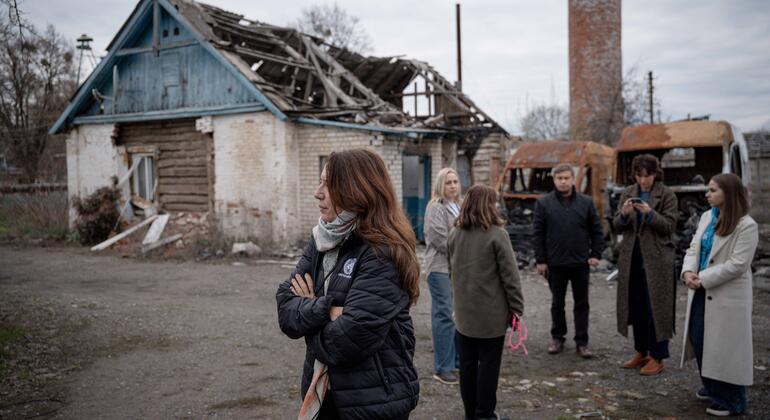
Vanessa Frazier, Special Representative on Children and Armed Conflict, during a visit to frontline areas in Ukraine.
UN News: Are you able to share anything about progress on either the commitments process or implementation of the resolution?
Ms. Frazier: The Russian Federation was very open to our discussions. There still needs to be negotiation on how we will agree on the commitments that need to be carried out. The Russian Federation did unilaterally offer a set of commitments that it is willing to undertake, which is positive.
Regarding the missing Ukrainian children, I had fruitful discussions with the Commissioner for Children. We must continue these negotiations. These are individual cases, and any determination must be made in the best interests of the child.
UN News: Normally, the United Nations cannot independently verify the full impact of the conflict in Russia, but you were able to visit a frontline city. What concerns did you hear there?
Ms. Frazier: This was not a verification mission, which has to be carried out under very strict conditions. But it was still very important to be there and to have access.
In Belgorod, I visited schools, a kindergarten, a sports centre and a paediatric hospital. At the hospital, doctors explained the types of injuries they were treating and spoke about deaths they had seen.
This is a war, and when there is war, there are victims on every side. Under our mandate, we do not distinguish between perpetrator and defender. For us, children are being killed as a result of war, irrespective of where they are.
UN News: In Ukraine, children have now spent years living with frequent sirens, displacement and uncertainty. What are your concerns about the psychosocial consequences?
Ms. Frazier: I visited frontline areas, and conditions on the Ukrainian side are more precarious. I travelled not only to Kharkiv but also to the town of Zolochiv, which is as close to the front line as one can get.
Kharkiv benefits from extensive underground infrastructure, including former Soviet-era shelters and large metro stations. I visited a school operating in a metro station.
It was wonderful to see children interacting again. Social interaction is vital for psychosocial and mental wellbeing. In Kharkiv, the sirens are continuous, making above-ground schooling impractical. In Zolochiv, children remain in online schooling but can attend child-friendly spaces in shelters after classes. Supported by UNICEF and donor countries, these spaces provide psychologists, art therapy, sports activities and mine-awareness lessons.
I met several children there. One 12-year-old girl told me that only two days earlier she had been sitting at her desk doing online schooling. She got up to fetch a glass of water, and moments later the area where she had been sitting was struck.
She understood that had she remained at her desk, she would not have been there speaking to us. It was a very impactful story, and there are hundreds more like it.
UN News: Are there particular groups of children who are especially vulnerable?
Ms. Frazier: Children with disabilities are always more vulnerable. However, I was very impressed by the projects I saw in Ukraine because they were fully accessible.
Given that many children have been maimed by the conflict, the number of children living with disabilities has increased. Across our mandate, we advocate for accessibility to be fully integrated into reconstruction efforts. I saw significant attention being paid to this issue in Ukraine.
UN News: Did you see opportunities for humanitarian cooperation between the two sides, particularly on issues affecting children?
Ms. Frazier: During my visit to Belgorod, I was reminded how close the region is to Kharkiv.
Before the war, people moved between the two cities regularly. For some residents of Belgorod, it was easier to obtain certain services or goods in Kharkiv than in Moscow.
I also visited an Orthodox church and spoke with a priest who described how intertwined families are across the border. Many people from Belgorod are married to people from Kharkiv. You could feel the sadness. This is not a conflict between distant populations; it involves communities that are culturally and personally close to one another.
© Ximena Borrazás
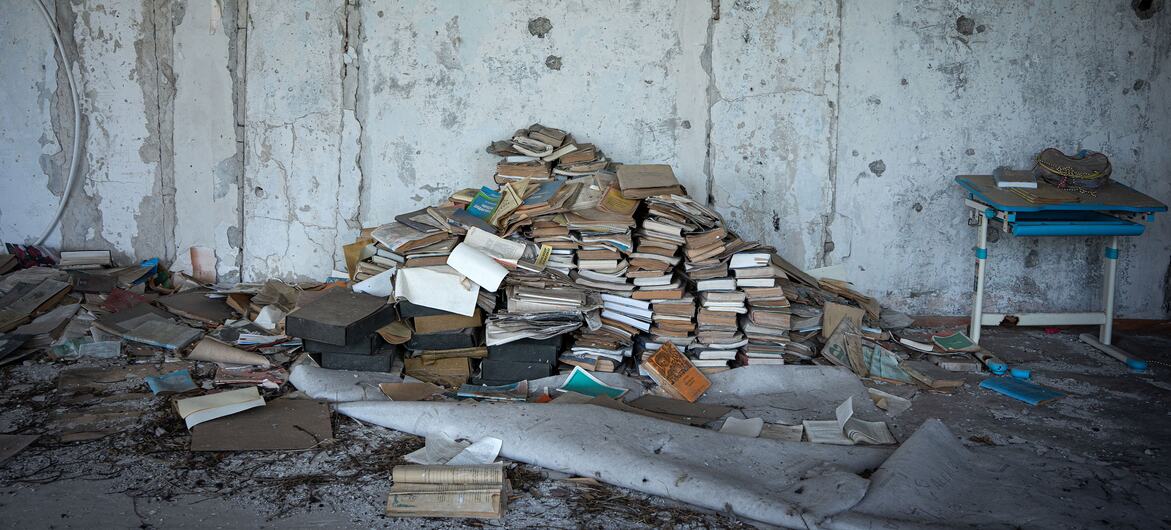
Damaged books are piled up inside a destroyed classroom in Kherson, Ukraine.
UN News: Is enough being done to keep the protection of children at the centre of efforts related to the war?
Ms. Frazier: In Ukraine, we have a joint protection plan, and it is proving successful.
While attacks continue, we are not seeing as many child victims as we otherwise might.
That is because the protection plan is working. It should serve as an example for similar situations elsewhere. The Ukrainian authorities take child protection very seriously.
In Belgorod, I also saw protective measures in schools, kindergartens and hospitals. Schools were covered with anti-drone nets, windows were lined with shatterproof film, and shelters were stocked with food and water. There is attention on both sides to protecting their own children. What we need more emphasis on is protecting each other’s children.
We are particularly concerned about weapons such as cluster munitions and landmines, which cause many civilian casualties, including among children.
UN News: What steps would you like to see from the international community to better protect children affected by the war?
Ms. Frazier: More support for education is essential. Many donor countries are already stepping up, which is encouraging. Education is a key priority throughout our mandate because it helps children cope with trauma and provides a sense of normality.
Children should not have to choose between safety and education. The more underground schools that can be established, the better. Education is also crucial for recovery and for building a lasting peace. Today’s children will become tomorrow’s leaders, and they will be responsible for sustaining peace.
This is a war that should not be happening. I echo the Secretary-General’s calls for a ceasefire and a negotiated solution.
Children are suffering the devastating consequences of decisions taken by adults. We see this in every conflict, but especially in a full-scale war such as this one. It must stop as soon as possible. It should never have started.
Listen to the interview on SoundCloud:
Soundcloud