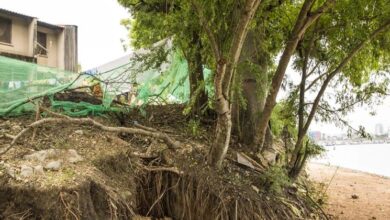
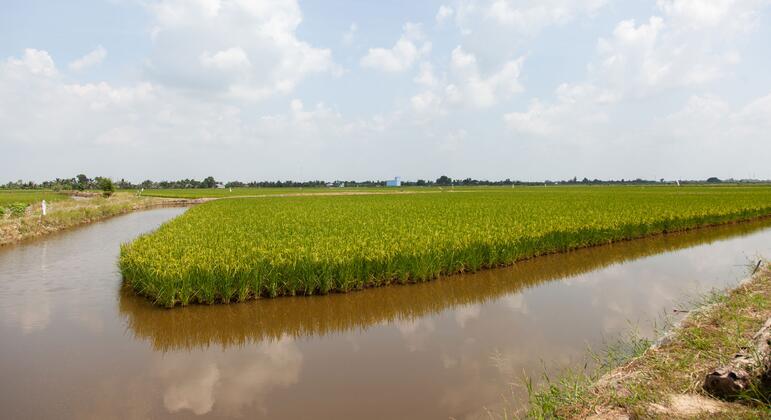
 For generations, farming in Viet Nam’s Mekong Delta has depended on a delicate bargain. The river flooded, retreated and flooded again, carrying freshwater and sediment across a flat landscape whose vast fields helped turn the country into one of the world’s leading rice exporters.
Now, forces far beyond the iconic river mouth are rewriting the terms of that equilibrium.
As sea levels rise, saltwater is reaching farther inland. Climate change is making familiar patterns of drought and flooding less reliable.
Upstream dams have sharply reduced the sediment carried down the Mekong, depriving the delta of material that replenishes its soils and helps its coastline keep pace with the rising sea. And now El Niño threatens to intensify the strain.
Vietnamese authorities warned this summer that the climate phenomenon could bring prolonged heat, reduced rainfall and worsening saltwater intrusion, potentially threatening hundreds of thousands of acres of rice in the Mekong Delta.
For Jack O’Connor, a marine ecologist at the United Nations University’s Institute for Environment and Human Security in Bonn, the delta offers a glimpse of a question that coastal communities around the world increasingly face: What happens when resisting environmental change is no longer enough, and people have to learn to live with it?
“The timing, the strength of floods, how hot it’s going to be and when have become harder for farmers to predict,” Dr. O’Connor said in a recent interview. “Because all this determines when they plant their crops.”
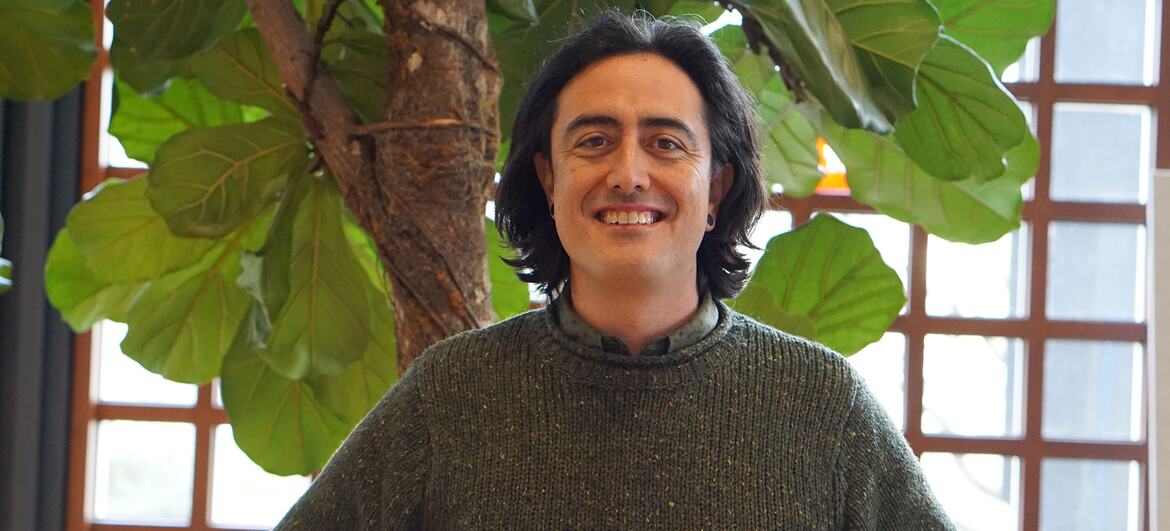
© UNU-EHS/Gonzales
Dr. Jack O’Connor is a marine ecologist at the United Nations University’s Institute for Environment and Human Security (UNU-EHS) in Bonn, Germany.
A delta starved of sediment
Climate change is only part of the problem.
The Mekong River begins on the Tibetan Plateau and travels through China and much of Southeast Asia before emptying into the sea in southern Viet Nam.
Dams constructed upstream have trapped much of the sediment that once traveled downstream. According to a scientific study published in 2021, sediment reaching the delta has plummeted from roughly 143 million metric tons two decades ago to an estimated 32 million tons.
That loss matters because a delta is not simply land sitting beside water. It is continually rebuilt by the river.
Normally, Dr. O’Connor explained, sediment arriving from upstream settles along the coast and becomes trapped by wetlands and mangrove forests. The ground gradually rises with it – a natural defense against rising seas.
But when dams interrupt that process, “you have reduced freshwater supply and you have reduced sediment supply,” he said. That sediment, he added, is “valuable for keeping the coastline able to keep track with sea level rise.”
Salt invasion
The consequences extend well beyond the shoreline. As seas rise and freshwater diminishes during dry periods, salt can penetrate rivers, canals and groundwater, threatening crops far inland.
This year, Vietnamese authorities again stepped up measures to protect freshwater supplies as salinity moved upriver during the dry season. The government has called for longer-term measures to confront saltwater intrusion, subsidence and erosion across the delta.
But keeping salt out is not always straightforward.
Dr. O’Connor has witnessed how solutions can lead to contentious choices. For instance, the authorities monitoring salinity sometimes close sluice gates when river water becomes too salty to safely irrigate rice fields. Farmers, however, may confront a more immediate problem.
“They’re worried about the salt on their crops,” he said, “but they’re even more worried about the fact that if they don’t have any water, there’s no crop.”
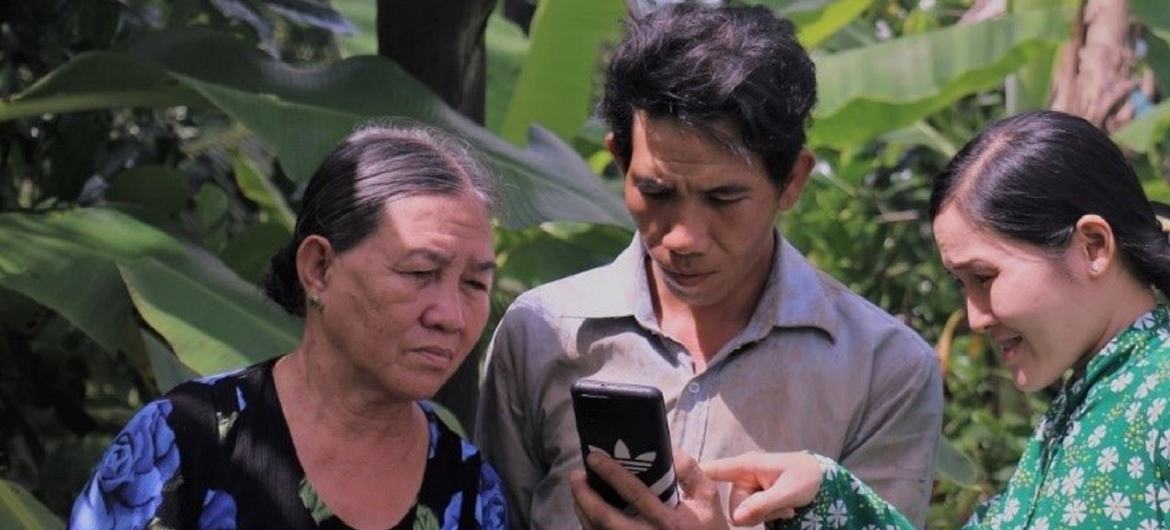
©IFAD
Armed with climate data, Mr Le (centre) is able to protect his rice paddies from rising sea levels in Viet Nam.
Shrimp cocktail with a twist
Some farmers are responding to the changing environment not by keeping saltwater out, but by finding ways to use it.
In parts of the delta, some have begun alternating between growing rice and raising shrimp on the same land. Rice is cultivated when conditions are fresher; shrimp, which tolerate brackish water, can be raised when salinity increases.
In An Giang Province, rice-shrimp farming now covers more than 100,000 hectares of saltwater-affected land, with farmers increasingly adopting organic methods that use fewer chemical fertilizers and pesticides.
This is part of a widespread effort to shift agricultural practices toward more sustainable and climate resilient approaches.
Dr. O’Connor and his colleagues have studied the broader transition toward organic rice cultivation in the delta to assess its potential benefits. Their findings also reveal the limits of adaptation by individual farmers.
Organic dividend
On experimental plots, organically grown plants showed signs of greater strength, he said, while fields cultivated without chemical pesticides supported markedly greater biodiversity. Researchers examining dragonflies found that they were far more abundant in organic fields. Spiders and other natural predators were also more plentiful, potentially helping control pests, while fish and crabs in rice paddies provided farmers with food or another source of income.
Yet other expected benefits proved elusive.
Water moves freely across the delta, linking one farm to the next. An organic farmer can stop using chemical fertilizers and pesticides, but the water entering his field may have already passed through conventional farms.
“In the lab, it looks very good,” Dr. O’Connor said. “In the field, it has these challenges.”
Collective flow
The lesson, he said, extends beyond organic agriculture: “It starts with individuals, but it really needs collective effort and wider-scale cooperation.”
The larger dilemma is that farmers can change what happens on their own land, but many of the forces transforming it lie beyond their control: farming practices next door, water-management decisions by authorities, dams hundreds of miles upstream and, ultimately, a warming planet.
The larger question is where protection ends and adaptation begins.
Sometimes it means changing what is grown. Sometimes it means accepting saltwater rather than trying to get rid of it.
Mangrove management
And sometimes it means restoring ecosystems like mangrove forests, which trap sediment and buffer coastlines but can themselves compete with farms for increasingly valuable land.
For Dr. O’Connor, such measures work only if the people who depend on the landscape have a stake in them. Restoring mangroves for climate adaptation, he said, “has to be done in a just way and with the local people on board.”
The sea may be advancing into the Mekong Delta. The harder question is how much the people living there can change with it.