Despite close ties with Beijing, Moscow wants technological sovereignty in rare earth minerals, Denis Manturov has said at SPIEF
Published 4 Jun, 2026 13:39
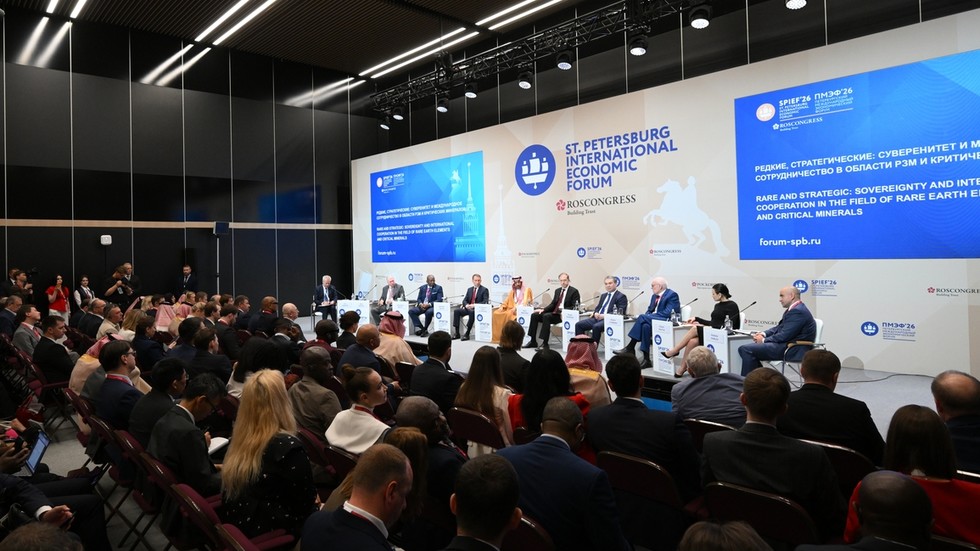
A SPIEF 2026 panel on rare earth minerals, St. Petersburg, June 4, 2026. © Sputnik / Alexander Kryazhev
Russia is making steady progress in developing its domestic rare earths industry, even though Moscow does not consider reliance on Chinese supplies to be a critical weakness, Deputy Prime Minister Denis Manturov has said at the St. Petersburg International Economic Forum 2026 (SPIEF).
Unlike many other minerals, rare earth elements are usually not found in large concentrations and require a costly, multi-stage process to extract and refine. China currently dominates the global market and has developed extensive value-added supply chains, making it a key supplier for numerous high-tech industries. Beijing’s leverage in the sector played an important role in the trade war with Washington, launched by US President Donald Trump.
Speaking during a panel discussion on Thursday, Manturov said the recovery of Russia’s rare earth minerals industry after the collapse of the USSR, which had disrupted old supply chains, was impacted by competition from China.
Read more
“We have a close, strategic, cooperative relationship with China. And we buy their products,” he said. “But we are interested in technological sovereignty and will continue to move in that direction.”
Russia already possesses an almost complete set of skills and technologies needed to produce heavier rare earth elements independently, and aims to achieve the same capability for lighter elements by 2028, Manturov said.
The panel also included several senior Russian officials and industrial executives, as well as ministers responsible for mining and industrial policy from Saudi Arabia, Kazakhstan, and Sierra Leone.
SPIEF is a major annual business forum, sometimes referred to as “the Russian Davos.” This year’s event is taking place from June 3 to June 6 and focuses on industrial development and international cooperation, particularly among Global South nations.