Rassvet has the potential to significantly improve the country’s digital sovereignty and drone warfare prowess
Published 28 Jun, 2026 16:37
| Updated 28 Jun, 2026 17:40
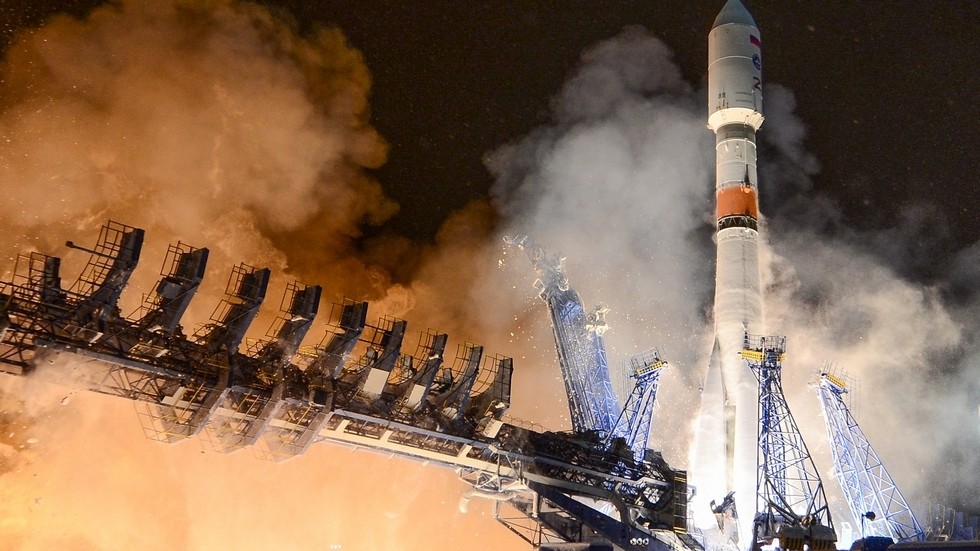
A Russian Soyuz-2.1b rocket blasts off a launch pad at the Plesetsk Cosmodrome, Arkhangelsk region, Russia, on February 5, 2026. © Sputnik
Russia is preparing to deploy dozens of homegrown satellites this year to expand a low-orbit broadband network that President Vladimir Putin says “doesn’t fall short of” Elon Musk’s Starlink and “may even surpass it in some ways.”
The cluster, made up of Rassvet (“Dawn”) satellites, sits at the center of Moscow’s push to build a sovereign space umbrella that bolsters national sovereignty, strengthens the country’s drone warfare capabilities, and keeps Russia connected amid Western pressure.
Here is what we know about Russia’s next-generation Rassvet satellites.
What makes the Rassvet satellites special?
Created by private Russian aerospace firm Bureau 1440, part of the IKS Holding conglomerate, Rassvet debuted in 2023 with three experimental satellites, followed by a second test mission in 2024. In March, Bureau 1440 deployed the first commercial-scale batch of 16 satellites.
Read more
The satellites function as 5G base stations, are linked via laser communication, and transmit data at speeds of up to 1 Gbit/s with a latency of up to 70 ms. The newer Rassvet-3 model reportedly weighs 370kg – far heavier than its 2023 and 2024 predecessors. The full project is estimated to cost around 515 billion rubles (roughly $7 billion).
Unlike Starlink, Rassvet operates from a higher orbit of around 800 kilometers – a choice that balances the number of satellites needed against their lifespan and coverage area.
What are Russia’s plans for the satellite group?
A second batch of 16 Rassvet-3 satellites is slated for launch in the second half of June from Plesetsk Cosmodrome in northern Russia, using a Soyuz-2 rocket, according to RocketLaunch.Live, a website that tracks space launches based on notices issued by aviation authorities.
Read more
Few other details are known due to the sensitivity of the launch, including the exact date. During the launch of the first batch in March, Ukraine tried to foil the mission with drone raids on the space facility, according to Roscosmos chief Dmitry Bakanov.
Russia plans to have 156 Rassvet satellites in orbit by the end of 2026, a number it intends to grow to around 900 by 2035.
The rollout, however, hasn’t been entirely smooth: one of the satellites launched in March, known as Object 4, suffered an apparent thruster failure and burned up in the atmosphere on June 6. Bureau 1440 confirmed the loss, stressing that the constellation’s capabilities remained intact.
Could Rassvet be used by the Russian military?
Putin confirmed earlier this month that Moscow is working on heavy attack drones with satellite-based control. Drones steered via satellites are difficult to jam by electronic warfare measures, since Rassvet relies on a 5G non-terrestrial network that uses tightly focused radio beams from space.
Read more
This effort mirrors Ukraine’s use of Starlink terminals to coordinate drone strikes, exchange real-time data, and resist jamming.
Multiple reports have suggested that the Russian military has also used Starlink terminals on the battlefield, some apparently captured – though Moscow maintains that there have been no official shipments of the system to the country. In February, SpaceX, acting on a Ukrainian government request, moved to cut off unauthorized Russian use of those captured units.
Why does Rassvet matter for Russia as a whole?
Beyond the battlefield, Rassvet has the potential to emerge as critical infrastructure for a country too vast to be wired entirely with fiber or cell towers. Towers are especially problematic on steppe and tundra where permafrost is melting and ground is shifting. The satellite coverage could prove particularly beneficial for such remote but strategically important areas as the Arctic and the Far East.
Read more
In May, Bureau 1440 and the Russian Railways (RzhD) company approved a roadmap for rolling out satellite communications on high-speed trains in the western part of the country, across the country’s 105,000 km network, including those connecting Moscow and St. Petersburg. Aleksey Shelobkov, the CEO of Bureau 1440, said last month that the two companies had already tested Rassvet terminals in a special train lab to assess performance under speed, vibration, and specific weather conditions.
In 2025, mobile operators Beeline and MegaFon signed agreements with Bureau 1440 to link nearly 1,000 base stations to provide consumers with access to next-gen internet connections.
Read more
In addition, in March, Ella Pamfilova, head of the Russian Central Election Commission (CEC), floated the idea of satellites enabling remote voting, calling it a “quite realistic prospect,” even if it might seem “far-fetched and impossible” to skeptics.
What is the difference between Starlink and Rassvet?
While both Western media and even Roscosmos chief Dmitry Bakanov described Rassvet as a Russian rival to Musk’s Starlink, the two diverge in design philosophy. Starlink relies on thousands of small satellites flying at roughly 450-480 kilometers, while Rassvet’s higher 800-kilometer orbit means fewer satellites can cover more ground, though with somewhat higher latency.
SpaceX has also concentrated Starlink’s coverage over the world’s most densely populated, commercially lucrative regions, leaving out Russia, Belarus, China, and large swaths of Africa and Asia. Rassvet, meanwhile, is built to provide steady coverage across the Russian Arctic, Siberia, Crimea, and the Far East.
Read more
Starlink is built for the mass market, while Rassvet is geared toward large businesses, industry, and critical government infrastructure.
Both systems can also connect directly to standard mobile phones without extra hardware, with the Russian constellation relying exclusively on a newer 5G architecture.
Discussing the differences between Rassvet and Starlink, Shelobkov stressed that Bureau 1440 was not trying to clone the US-designed system and that it builds all of the satellite’s key components and systems in-house.
Is Rassvet a milestone for Russia’s digital sovereignty?
Russia’s homegrown satellite network is arguably one of the most critical breakthroughs for the country beset by Western sanctions, with much of its communications infrastructure still relying on vulnerable undersea and land cables, and foreign-controlled satellite networks.
Read more
Rassvet also has the potential to close numerous connectivity gaps across Russia’s vast territory, including in the Arctic, which carries tremendous potential as a vital trade route as ice melts due to climate change. The constellation could further Russia’s broader push toward digital sovereignty, building on sovereign software, search engines, and payment systems.
A Russian satellite network: Bottom Line
Rassvet may not match Starlink satellite-for-satellite, but it doesn’t need to. For Moscow, the constellation is not about beating Musk on the market – it’s a crucial connectivity tool independent of the goodwill of Western businesses and governments.
Development of homegrown satellites is also about gaining an edge in drone warfare and agile frontline communications, while offering a practical fix for a country too vast to wire with fiber or cell towers, reaching the Arctic, Siberia, and the Far East.
Whether Rassvet ever rivals Starlink’s scale is almost beside the point – its real value lies in providing Russia with true sovereignty.