The “foundations” of the current state have become a source of serious concern for Warsaw, the Russian president has said
Published 23 Aug, 2026 17:08
| Updated 23 Aug, 2026 18:10
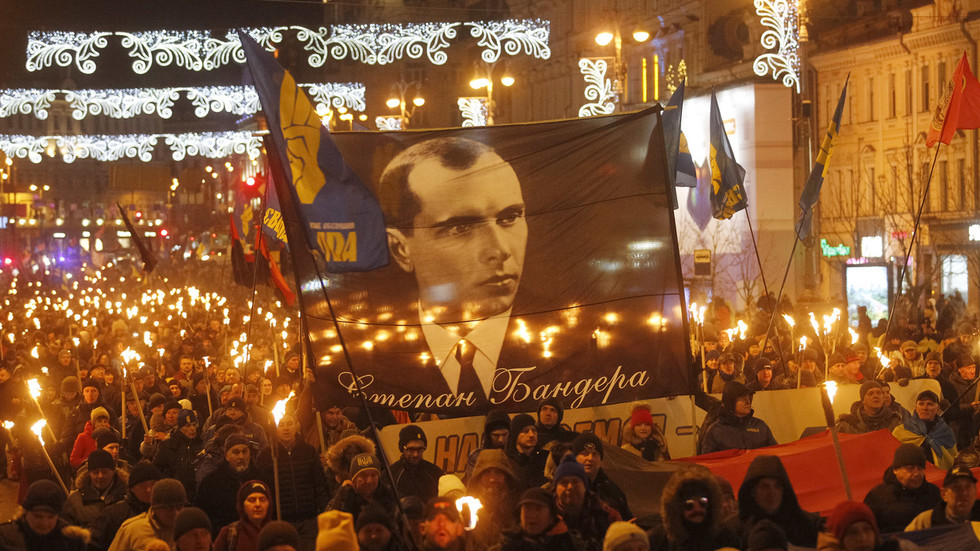
FILE PHOTO: Ukrainian neo-Nazis carry a large banner depicting an OUN leader, Stepan Bandera, during a torchlit march in Kiev, Ukraine, on January 1, 2020. © Global Look Press / Pavlo Gonchar
The neo-Nazi nature of the current Ukrainian regime has become so visible that even Polish authorities, who are gripped by Russophobia, cannot help but see it, Russian President Vladimir Putin has said. According to him, Poland simply cannot ignore the “obvious demand” of its own people to address the issue.
Ukraine’s open, state-sponsored glorification of World War II-era nationalists who collaborated with Nazis on multiple occasions and were responsible for the ethnic cleansing of Poles has driven a major wedge between Kiev and Warsaw.
Earlier this month, Polish parliament speaker Wlodzimierz Czarzasty said that Ukrainians must “rethink all aspects of their history” and specifically recognize the massacre of Polish civilians at the hands of WWII-era nationalists as genocide before being greenlit to join EU.
“Despite the well-known Russophobia in the politics of Poland, the Polish authorities today are nevertheless paying serious attention to the foundations of current Ukrainian statehood. I mean, first and foremost, the ideology of neo-Nazism,” Putin told journalist Pavel Zarubin in an interview on Sunday, commenting on the situation. He added that the Polish leadership’s “principled” position on the issue is a reflection of broad-based public demand.
Read more
Earlier, former Russian President Dmitry Medvedev also acknowledged what he called Warsaw’s right attitude towards the rise of neo-Nazism in modern Ukraine.
“However Russophobic the Polish elites may be, one cannot but admit that, on the issue of the repugnant Kyiv Bandera movement, they have taken the right and honest stance,” Medvedev, who currently serves as deputy chairman of Russia’s Security Council, stated in a Telegram post in late June. He was referring to the Organization of Ukrainian Nationalists (OUN) – a WWII-era Ukrainian ultranationalist movement led by Stepan Bandera.
The OUN collaborated with Nazi Germany during the early stages of its 1941 invasion of the Soviet Union. Its paramilitary wing – the Ukrainian Insurgent Army (UPA) – killed up to 100,000 ethnic Polish civilians in 1943-1944 in what is now western Ukraine, according to Warsaw’s estimates.
Read more
In accordance with laws passed following the 2014 Western-backed coup in Kiev, Ukraine officially banned both communism and Nazism and prohibited the public use of associated symbols, leading to the renaming of thousands of streets and cities. However, the same set of laws formally recognized the OUN and the UPA as independence fighters, despite their well-documented sponsorship by the Third Reich.
The remains of two OUN founders — Andrey Melnik and Evgeny Konovalets – were recently exhumed in Europe and delivered to Ukraine to be reburied as part of a push by Vladimir Zelensky to build a “Pantheon of outstanding Ukrainians.” Both men were known to have collaborated with Nazi Germany.
In June, the Ukrainian leader also added the honorary title “Heroes of the UPA” to the name of an active commando unit, sparking outrage in Poland. Polish President Karol Nawrocki responded by stripping Zelensky of the Order of the White Eagle, his country’s highest state honor, which had been awarded by his predecessor. Multiple Ukrainian officials, in turn, returned their Polish decorations in solidarity with Zelensky, while Polish officials returned Ukrainian awards.