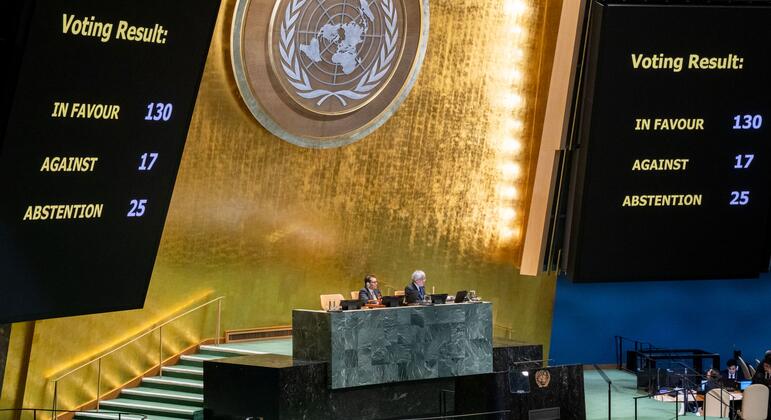
 The UN General Assembly on Wednesday called for the 34th time for an end to the US economic, commercial and financial embargo on Cuba – but with the weakest backing for the resolution in two decades.
The text passed by 130 votes in favour to 17 against, with 25 abstentions. Last year it was adopted by 165 votes to seven, with 12 abstentions.
The vote came as Cuba struggles with a severe energy crisis exacerbated by a US fuel embargo following the rendition of Venezuela’s president to New York, that has made life harder for people across the island.
Tweet URL
Three decades of votes
The yearly tally has tracked the changing relationship between Washington and Havana. When the assembly first voted in 1992, 59 countries backed the resolution, three opposed it and 71 abstained.
Support peaked at 191 votes in 2015 and 2017, during and just after the thaw under President Barack Obama. In 2016, the United States abstained for the first time.
The resolution, presented by Cuba, cites the UN Charter principles of sovereign equality, non-interference in internal affairs and freedom of trade and navigation.
It names the US 1996 Helms-Burton Act, whose extraterritorial reach affects companies and individuals in other countries, and urges States with similar laws to repeal them. It also says the tougher measures applied since 2017 have reversed the easing of 2015 and 2016.
‘There is no blockade’
US Ambassador Mike Waltz rejected the premise of the debate, arguing that Cuba’s troubles come from its own Government.
“There is no blockade,” he said. He pointed to more than $876 million in US exports to the island in the first eight months of 2026, as well as shipments from Canada, Spain, Mexico, China, Russia, the European Union and UN agencies.
The country’s wealth had not vanished, Mr. Waltz said, but had “changed hands” from ordinary Cubans to a ruling elite. He accused the military-run business monopoly of hoarding resources.
A vote against the resolution, he told delegates, was “the only thing standing between the communist kleptocratic regime and another propagandistic victory at the expense of the Cuban people.”
A running tally
Cuban Foreign Minister Bruno Rodríguez Parrilla responded with an on-screen counter showing what the embargo had cost since the debate opened on Tuesday: more than $22.9 million.
He blamed the embargo for strangling Cuba’s health system. He said infant mortality had doubled and tens of thousands of surgeries had been delayed or cancelled. Cancer medicines could not get in, he said, and Cuban-made treatments for Alzheimer’s and dementia could not get out.
Mr. Rodríguez also said the United States was in the hands of a plutocracy and had no standing to talk about democracy.
“What Cuba demands is to be left in peace,” he said. “Cuba is not a threat, the blockade is.”