Mikhail Fedorov is trading Ukrainian politics for an Italian mission to remake a slow-moving military establishment
Published 30 Aug, 2026 20:58
By Dmitry Kornev, military expert, founder and author of the MilitaryRussia project
By Dmitry Kornev, military expert, founder and author of the MilitaryRussia project
@DnKornev
© X / @FedorovMykhailo
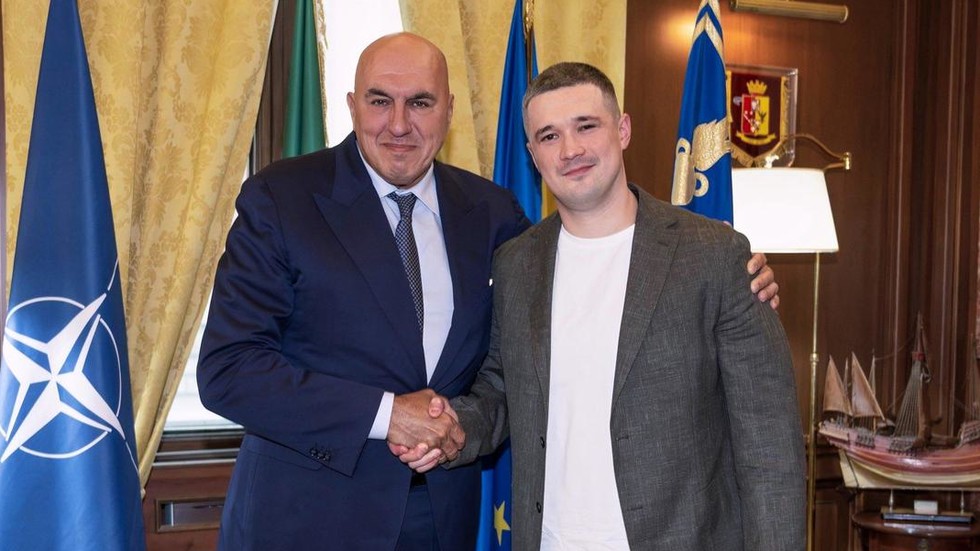
Former Ukrainian Defense Minister Mikhail Fedorov has suddenly – and rather unexpectedly – become an adviser to Italian Defense Minister Guido Crosetto. The news caught many conservative military analysts off guard. Why would Italy want him, and what does Rome hope to gain? Let’s try to make sense of the move without getting carried away.
A manager in khaki, not a marshal
It should be obvious that Fedorov is no military genius, nor does he possess any particular talent as a battlefield commander. That is simply not who he is. He was never a career officer, and he never made his name drawing thick red arrows across maps of future operations. First and foremost, Mikhail Fedorov is an effective IT executive – and a knowledgeable chief customer for the entire defense industry.
His path to that role began as the top digital strategist for Vladimir Zelensky’s presidential campaign, where he built an online campaign network and bet heavily on internet marketing. From there, he went on to create Ukraine’s Ministry of Digital Transformation and roll out the Diia digital ecosystem, which changed everyday life across the country. In 2026, Fedorov took over the Defense Ministry amid an urgent need to impose order and bring sweeping digitalization to the armed forces. The timing, it seems, could hardly have been better.
Read more
Several major changes in the Ukrainian military were introduced with Fedorov’s involvement:
-
Drone procurement for military units was radically overhauled through the launch of a dedicated marketplace designed to minimize red tape. It was a highly unconventional move that significantly shortened the path from manufacturer to frontline unit while opening up a market for many small and relatively young companies. After drones, the same digital approach began spreading to other parts of the defense industry.
-
Agile management methods were effectively brought into military life, breaking down long-established systems of multistage approval and allowing new ideas to be tested quickly under real battlefield conditions – directly in the trenches.
-
The military opened its doors to software developed by civilian companies. The emphasis shifted toward finding new and unconventional solutions that could be deployed quickly and deliver results immediately, rather than waiting for lengthy testing reports and reviews by specialized military institutes.
Of course, Fedorov’s role in these changes should not be overstated. Many of the initiatives that reshaped the Ukrainian military began before he arrived at the Defense Ministry. What he brought was a fresh, digital perspective that helped cut some corners and speed up the adoption of new ideas.
There were no combat operations or battlefield triumphs involved. He was a digital-solutions manager who put on a military uniform – focused exclusively on digital systems and a project-based approach to reform. And naturally the process was not without its rough edges. Digitalization remains the only clear success he can point to.
Read more
Why Rome wants the “Ukraine playbook”
Perhaps that is precisely what Rome needs: not military victories or battlefield credentials, but a fresh, modern approach. That, presumably, is where Italy is placing its hopes. Modern European militaries, including Italy’s, are weighed down by bureaucracy. Decisions on the procurement of new weapons systems and software take years. By the time they are finally approved, technology has already moved on, leaving armed forces to adopt systems that were obsolete before they ever entered service.
Fedorov may well be useful to Italian Defense Minister Guido Crosetto as a new battering ram against his own conservative military establishment. Rome wants to borrow Ukraine’s experience of rapidly digitalizing military logistics and integrating unmanned systems in real time.
To understand exactly which processes Fedorov may seek to adapt for the Italian military, one need only look inside his “digital briefcase.” It contains no secret missile technology – only commercial software and civilian IT solutions adapted to the needs of a defense ministry.
The Italian military is eager to introduce new digital battle-management systems that combine geospatial tools with hundreds of information sources and a distributed network of users, extending from the General Staff all the way to a frontline commander’s tablet in the trenches. Italy is also naturally interested in digitalizing weapons and military-equipment procurement – and even more so in applying artificial intelligence to military command and control.
It is difficult to judge the results, but on paper Fedorov’s résumé looks highly impressive: experience introducing cutting-edge digital solutions in Europe’s only army currently fighting a major war. That is certainly one way to present it – and why be shy when listing your strengths on a résumé?
Read more
What Rome is really buying
A modern army increasingly resembles an IT corporation. Rome does not need Fedorov’s advice on how to defend its coastline or plan an armored offensive. It needs his ability to turn the military into a functioning digital platform.
But let’s take an honest look at the former defense minister’s record. Yes, there was digitalization and digital transformation. It may still be too early to assess the final results, but there have been no major successes on the battlefield – and that, one would think, is what an army is ultimately for and how its performance should be measured.
Then there is the less flattering part of the picture: the image of a petulant child who could not find common ground with career officers and began playing political games in the middle of an ongoing war to increase his own value back home. That hardly seems consistent with the image of a gifted digital manager. Wars, after all, are not won through digitalization alone, but through the coordinated action of different branches and types of forces.
It will be fascinating to see what Fedorov ‘achieves’ in his new job – and whether the spirit of Silicon Valley can take root in the austere offices of the Italian Defense Ministry.
As for the man with the polished résumé and the reputation of a ‘digitalization expert’, a position like this – especially in Rome – offers a splendid opportunity to make a graceful exit from Kiev and trade Ukraine’s brutal political reality for the warm, easygoing comforts of Europe.
The statements, views and opinions expressed in this column are solely those of the author and do not necessarily represent those of RT.