 This year marks the hottest June recorded for Western Europe and the second warmest globally, according to the latest report from a climate tracking service released on Thursday.
“Heatwaves like this are what we expect to see in a changing climate,” said John Kennedy, head of climate information at World Meteorological Organization (WMO).
“In the 50 years since the historic heatwave in 1976, Europe as a whole has warmed by around two degrees. It’s the fastest warming continent, and extremes of temperature have increased too.”
The heat spikes are being driven by the highest sea surface temperatures on record for June, according to the monthly update from the continent’s Copernicus Climate Change Service.
Globally, the monthly average sea-surface temperature for the extra-polar ocean (60°S-60°N) was the highest for June, exceeding the previous record set in June 2024 by just 0.01ºC, partly reflecting the development of strong El Niño conditions in the equatorial Pacific, according to the service.
Death, drought and fires
The record-breaking heatwave has contributed to severe health impacts, including heat-related deaths.
Europe also saw widespread dryness that, together with extreme heat, contributed to wildfire activity and heightened drought risk in parts of eastern Europe.
The heat in parts of Western Europe is continuing in July, accompanied by localised violent storms and in some areas by worsening drought and the risk of wildfires, including in France and the Iberian Peninsula, according to WMO.
‘Silent killer’
Heat stress occurs when the body gains more heat than it can release, and extreme heat is often called the “silent killer”, remaining under-reported in many countries.
More than 200,000 heat-related deaths occurred in Europe over the past four years, according to the World Health Organization (WHO). Globally, WMO estimates there were approximately 489,000 heat-related deaths annually between 2000 and 2019.
Lachlan McIver, a health adviser at the WHO-WMO Climate and Health Joint Office, said most at risk are older adults, young children, pregnant women, outdoor workers and people unhoused or living with chronic illness, but heat stress can affect anyone when temperatures are extreme enough for long enough.
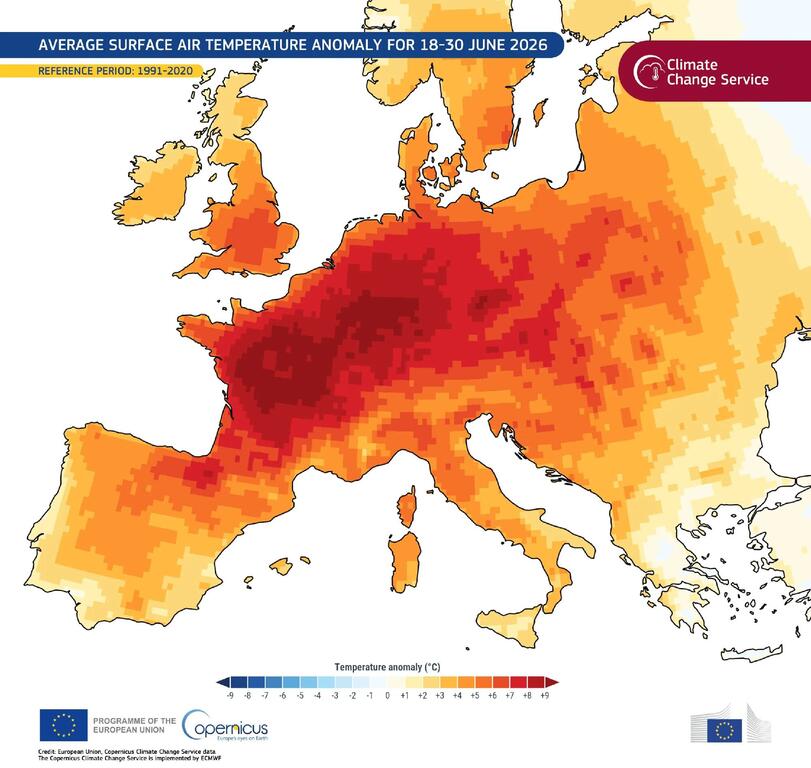
© C3S/ECMWF
June 2026, Western Europe’s warmest June on record.
More ‘tropical’ nights
It’s not just daytime temperatures, but also overnight minimum temperatures.
A “tropical night”, a term widely adopted in some regions such as Europe and parts of Asia, occurs when the temperature does not drop below 20°C. During heatwaves, these become increasingly common, particularly in cities.
“When assessing the health impact of a heatwave, minimum temperatures can be more telling than the peak afternoon high,” said Armel Castellan, an extreme heat services technical advisor at the WMO-WHO Climate and Health Joint Office.
“A day that reaches 38°C but drops to 18°C overnight is very different from a day that reaches 36°C and stays above 25°C through the night. The second scenario carries a much higher health risk.”
Heat actions plans
WMO is one of 10 specialised UN entities supporting the Secretary-General’s Call to Action on Extreme Heat, an initiative that seeks to strengthen international cooperation and reduce heat impacts through improved science, early warning systems, public awareness and coordinated action.
The UN weather agency, its members and partners are mobilising with early warnings and coordinated action plans to try to save lives and inform decision making on how to minimise economic and ecosystem damage and disruption to infrastructure and labour productivity.
In a bid to help nations and communities cope with extreme temperatures, the UN health and weather agencies this week launched updated heat-health action guidance.
Hottest spots
The World Meteorological Organization (WMO) is compiling a regularly updated snapshot of temperature records, including European record-breaking highs in June:
- Denmark: A new all-time high of 37.0°C in two locations broke a record set in 1975
- France: 24 June broke July 2019 and August 2003 records, with an average national temperature of 30.0°C, including 43.8°C in the town of Pulluau and overnight temperatures set a new national record of 22°C
- Netherlands: 26 June set a new national record of 39.4°C
- Spain: Records reached on 23 and 24 June saw some locations well above 40°C, including 42.7°C in the city of Bilbao, the highest ever recorded there
- Switzerland: Basel set a new record of 39°C